
Query Fan-Out Explained
Query Fan-Out Explained
Learn what query fan-out is, how AI breaks one question into multiple sub-queries, and why optimizing for them improves AI search visibility.
Haritha Kadapa

Highlights
Query fan-out breaks questions into sub-queries: AI platforms split one user prompt into multiple related searches and combine the results into a single answer.
AI visibility depends on topic coverage: Content that answers a full cluster of related questions has a better chance of being cited than content targeting one keyword.
Query fan-out follows a three-step process: AI understands intent, generates sub-queries, searches for answers, and merges the results into one response.
Structured content improves citations: Clear headings, direct answers, comparisons, and related sub-topics make content easier for AI models to extract and cite.
Fan-out is visible in AI responses: Long-form answers with multiple sections and citations often reflect several sub-queries working together.
Your brand can answer the question a buyer asks AI and still get left out of the answer. The problem is often not the main query. AI search can break one buyer question into several smaller questions, and your content may answer only one of them.
When you ask any AI platform a question, it first breaks your question into several smaller questions, runs each one, and stitches the results into a single response. This process is called query fan-out, and it is one of the main reasons AI search behaves so differently from traditional search.
If you work in content or marketing, understanding this process changes how you think about ranking. You are no longer optimizing for one query. You are optimizing for a whole cluster of questions an AI model might generate on your behalf.
What is a query fan-out?
Query fan-out is the process of search query decomposition and multi-query retrieval where an AI search system takes one user question and splits it into multiple related sub-queries before generating an answer. Each sub-query is sent out, results come back, and the AI model combines everything into one response.
For example, someone might ask, "What is the best CRM for a small marketing team?" The AI system may generate sub-queries like "top CRM tools for small teams," "CRM pricing comparison," and "CRM features marketing teams need." Simply put, the final answer draws from all three searches, not just the original question.
Why does a query fan-out matter for AI search visibility?
Query fan-out matters because it multiplies the number of chances your content has to get cited or get skipped.
A single blog post that answers only the exact phrase a user typed will miss most of the sub-queries. That implies AI search visibility now depends on how well your content answers a full spread of related questions, not one keyword.
How does query fan-out work?
Query fan-out generally follows three steps.
First, the AI model interprets the intent behind the user prompt and identifies the distinct sub-topics it contains.
Understand Intent Intelligence: Why Users Ask What They Ask
Second, it generates several sub-queries, each targeting one of those sub-topics.
Third, it runs those sub-queries against its index or live search, gathers the results, and synthesizes them into a single answer. Recent research on query decomposition similarly explores breaking complex questions into targeted sub-queries, retrieving evidence for each one, and combining the results to answer the original question.
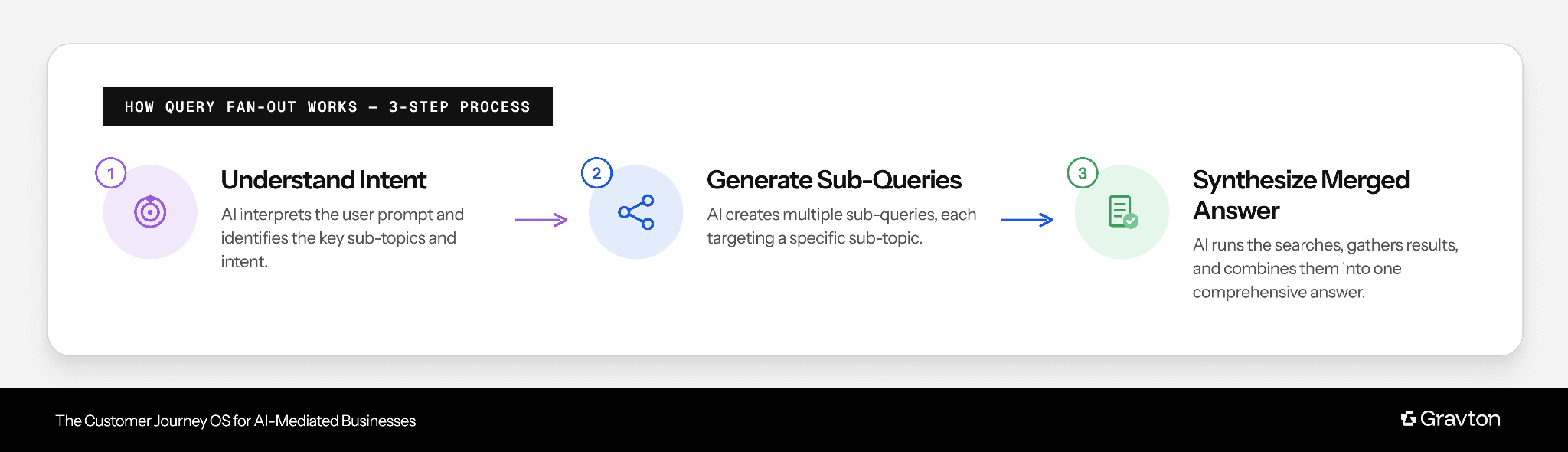
Figure 1: How query fan-out works.
This is closely related to AI query expansion, one of the older AI search techniques, where a system adds related terms to a query to widen the pool of matching results. Google Research has studied how generating and aggregating expanded queries can improve retrieval performance in neural search systems.
Among modern AI search techniques, fan-out goes further. Instead of just adding terms, it creates entirely separate sub-queries and treats each one as its own search.
Who uses query fan-out in AI search?
Modern AI search systems can decompose complex questions into multiple searches or retrieval steps, although the exact process differs by platform. The exact mechanics differ by platform, but the underlying goal is the same: break a broad question into parts the system can research more precisely.
Content teams and SEO practitioners also need to understand this process, even though they do not control it directly. Once you know how a platform decomposes a topic, you can structure content to answer the sub-queries before they are even asked.
When does query fan-out happen?
Query fan-out happens most often when a question is broad, comparative, or multi-part, because there is not one clear answer to look up.
A narrow factual question, such as "What year was a company founded," rarely triggers fan-out.
A question like "How do I choose a CRM for my team," on the other hand, contains several implicit sub-questions about price, features, integrations, and use case, so the system fans it out.
Fan-out is also more common with newer or evolving topics, where no single page fully answers the question and the model needs to combine partial answers from several sources.
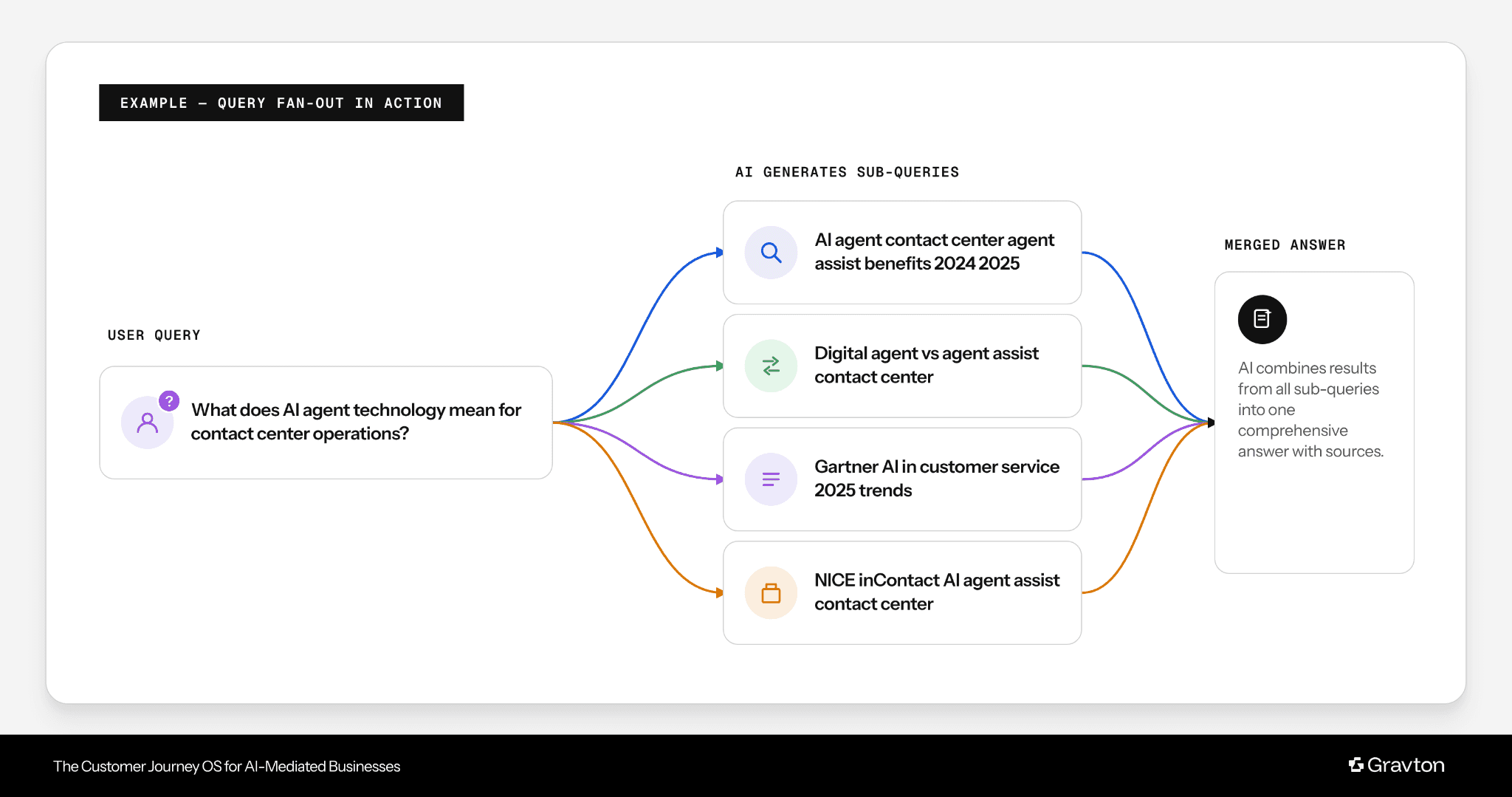
Figure 2: Example of a query fan-out.
Where does query fan-out show up in AI answers?
You can usually spot the effects of this process by looking at the structure of an AI response.
Long-form answers organized into sections, bullet points, or comparison tables are often stitched together from separate sub-queries, each pulling from a different source. Citation patterns tell the same story. If a single AI answer cites four or five different domains instead of one, it is likely the product of fan-out.
Sub-queries in AI search are usually invisible to the end user. You only see the final merged answer, but the sources behind each section reveal which sub-query pulled from which page.
How can you optimize content for query fan-out?
The most reliable way to optimize for a query fan-out is to cover a topic as a complete cluster rather than a single page targeting one phrase or a keyword.
Follow the inverted pyramid style and answer the main question directly near the top. Follow that with the sub-questions a reader or an AI model would naturally ask next: pricing, comparisons, use cases, limitations, and alternatives.
Use clear headings for each sub-topic so a model can match a sub-query to the right section of your page.
Structure also matters as much as wording. Short, direct, well-labeled sections are easier for an AI model to extract and cite than long unstructured paragraphs.
Gravton's view
Gravton's Insights Engine is built around this exact idea: it tracks which prompts and sub-queries are being generated around your topics, so you know which parts of the cluster you are missing before you write a single sentence.
Query fan-out is becoming an important part of AI search for broad, comparative, and multi-part questions. It is especially useful when one search is unlikely to provide enough information for a complete answer. Brands that keep publishing single-angle content built for one keyword will keep losing citations to competitors who cover the full sub-query cluster.
This is why Gravton Labs tracks AI search visibility at the sub-query level, not just the headline prompt. Our AI visibility platform maps the sub-queries forming around your topics, and shows gaps and opportunities. That is exactly which parts of the cluster your content is missing, and our Opportunity Engine prioritizes which gaps to close first. From there, AI-ready content built through our Content Studio is structured so an AI model can match it to the sub-query it answers.
If you want to see which sub-queries are already fanning out around your topics and where your content is missing from the answer, request your AI visibility snapshot.
FAQs on Query fan-outs
Is query fan-out the same as AI query expansion?
No. AI query expansion adds related terms to a single search. Query fan-out creates several distinct sub-queries and runs each one separately before merging the results.
Does query fan-out affect every AI search response?
No. It is most common with broad, comparative, or multi-part questions. Simple factual questions with one clear answer often skip fan-out entirely.
Can I see which sub-queries an AI model generated for my topic?
Not directly from the AI platform itself. Tools built for AI search visibility, like Gravton, track sub-query patterns by running structured prompt sets and monitoring which sources get cited for each one.
Find your AI search visibility gaps
See which questions surface your brand, which ones send buyers to competitors, and where your content has visibility gaps.
VISIBILITY & CONTENT STRATEGY