
robots.txt vs llms.txt: From Crawling to Comprehension
robots.txt vs llms.txt: From Crawling to Comprehension
Understand the difference between llms.txt and robots.txt, why both matter for AI search, and how they shape your brand's visibility in AI responses.
Haritha Kadapa

Highlights
robots.txt vs. llms.txt: robots.txt controls which pages crawlers can access. llms.txt gives AI systems a structured summary of what your site contains, so they don't have to infer it.
A directory, not a training signal: llms.txt is a curation and discovery mechanism. No major answer engine has confirmed it as a ranking or citation factor.
Measure what AI actually says: the only way to know if llms.txt and your AI optimization efforts are working is to track how platforms like ChatGPT, Gemini, Claude, Perplexity, Grok, and Copilot reference your brand across real buyer prompts.
llms.txt is one piece of the puzzle: accurate AI recommendations still depend on structured content, authoritative external citations, and consistent signals across the web.
SEO and GEO work together: robots.txt handles crawling, llms.txt supports AI comprehension. Both are worth maintaining.
Until recently, robots.txt was the only file that shaped how the web saw your site: simple, binary, effective, because search was simple and binary.
Buyers now ask AI platforms questions like "What's the best all-inclusive safari camp in Kenya under $1,000 per night?" and get a synthesized answer, not a list of blue links. The brands that show up aren't necessarily the ones ranking highest on Google. They're the ones whose content an AI system could parse and use with confidence.
llms.txt is trying to close that gap. This article walks through what it actually does and doesn't do, so you can decide how much of a strategy to build around it.
What robots.txt does, and was never built to do
robots.txt is a crawler access-control protocol that has existed since 1994. It tells bots which pages they may or may not index: block a directory, allow a bot, disallow a subfolder. It was built for a world where bots crawl → pages index → users rank. That loop still runs, but robots.txt says nothing about what an AI system should do with your content once it's inside, or what your brand actually offers.
→ robots.txt answers: can you enter?
→llms.txt answers: once you're inside, here's what matters.
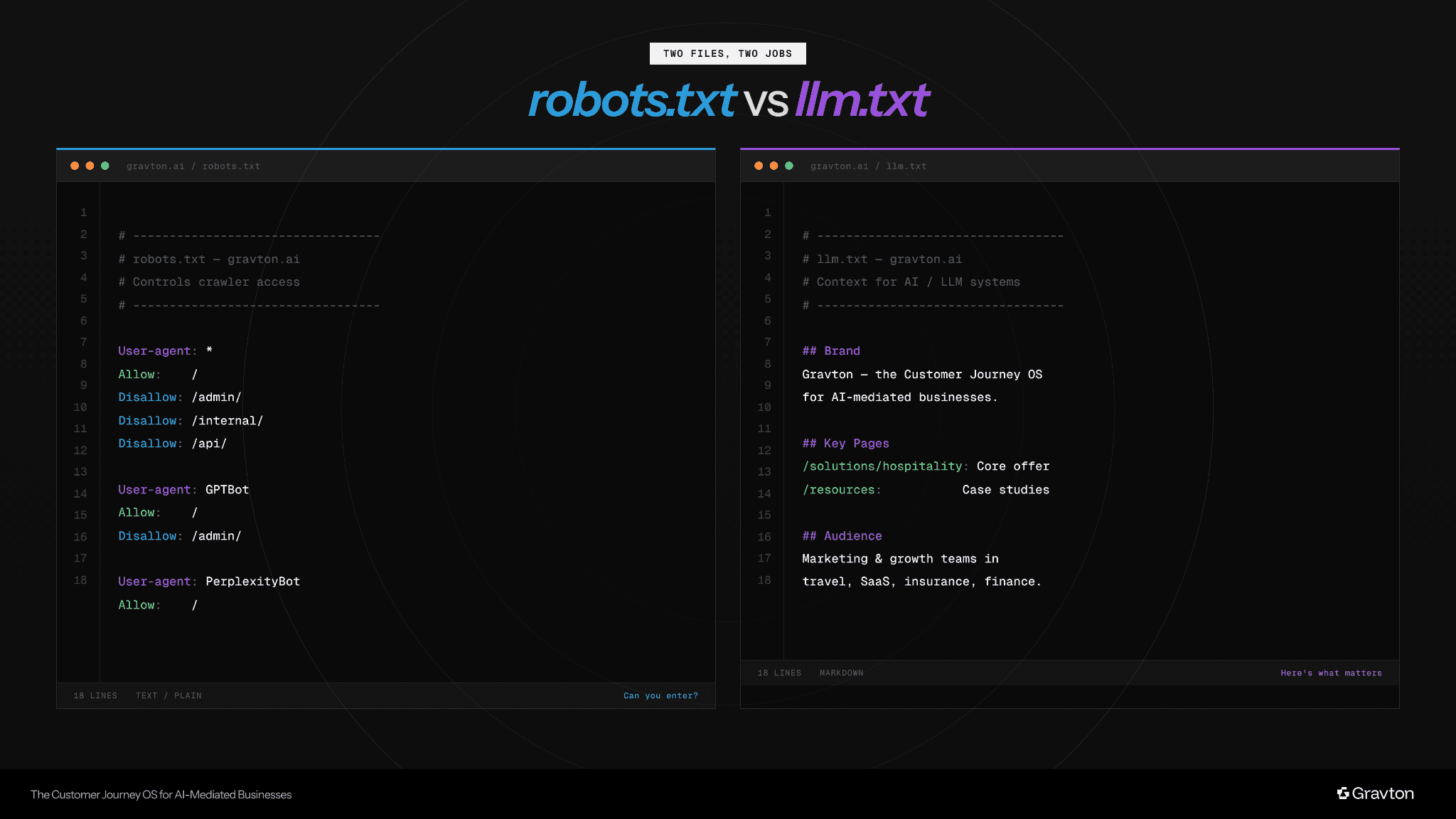
Figure 1: robots.txt and llms.txt.
What llms.txt actually is
llms.txt is a proposed convention for providing language models with a structured, human-authored summary of a site, rather than letting them crawl hundreds of pages and infer what you do. It was proposed by Jeremy Howard of Answer.AI on September 3, 2024, as a markdown file served at the site root (yourdomain.com/llms.txt). llms.txt typically covers what the brand does, which pages are most authoritative, how content should be contextualized by audience and intent, and what's excluded from AI training.
Adoption is early but real. Anthropic, Stripe, Mintlify, and Vercel have all published llms.txt files for their documentation, largely to help coding assistants navigate their docs more reliably.
Note on naming: /llm.txt (no "s") shows up occasionally as a variant, but it isn't the canonical convention. The standard and the search volume are in/llms.txt.
Why it matters, and why it's easy to overstate
Across travel, SaaS, financial services, e-commerce, and healthcare, buyers are shifting research toward AI platforms. They form a consideration set before they ever land on a brand's website. That's a problem robots.txt can't touch: even flawless indexing and high domain authority don't guarantee that an AI platform will cite you or include you in the responses that now function as the first stage of the buying journey.
Here's the honesty gap worth naming directly: publishing llms.txt does not currently make an answer engine more likely to cite you. No major AI platform has confirmed it as a retrieval, ranking, or citation input. What it does do is give any system that chooses to read it a cleaner way to understand your site than crawling and guessing.
The pattern that actually drives citations is the same as always. The content should be structured for extraction, backed by real evidence.
robots.txt vs llms.txt: side-by-side
Dimension | robots.txt | llms.txt |
Primary function | Access control for crawlers | Structured context for language models |
Audience | Search engine bots | Large language models / AI tools |
Format | Allow/disallow directives | Structured markdown |
What it communicates | Which pages to crawl or skip | What the brand does, what matters, how to interpret content |
Confirmed impact on visibility | Search indexing | None confirmed yet; early-stage convention |
Existed since | 1994 | Proposed September 3, 2024 (Jeremy Howard, Answer.AI) |
Relevant to | SEO | GEO, documentation UX |
Can block AI crawlers? | Yes, if the bot respects it | No, it informs rather than restricts |
Known adopters | Effectively all web properties | Anthropic, Stripe, Mintlify, Vercel |
The measurement layer llms.txt can't replace
Configuring llms.txt and structuring content for AI retrieval are reasonable steps, but neither tells you if they're working. That takes
Presence: tracking how AI platforms actually reference your brand: whether you show up at all
Position: where you sit when you do, and there's no page two in an AI answer
Share of voice: your share of mentions versus competitors'
Sentiment & framing: how you're framed when named, either a definitive source or one option among several
Citation source: and which pages the answer engine is actually pulling from.
See See AI Sentiment Analysis: How Tone Shapes Brand Perception
and
AI Narratives: What They Are and Why They Shape Buyer Decisions
What a well-configured llms.txt should include
The convention is still evolving, but the strongest implementations share a few common elements:
A clear brand summary: what the company does, who it serves, what makes it distinct),
Page hierarchy: which pages are most authoritative on which topics
Audience and intent signals: who each content area is written for
Any content excluded from AI synthesis: for brands with legal or proprietary reasons, and
Entity relationships: explicit links between your brand, product names, and the topics you want associated with you.
Key takeaway on robots.txt vs llms.txt
robots.txt and llms.txt do different jobs, and treating llms.txt as a shortcut to citations misreads it.
robots.txt → Configure which bots can access which content. Check that your disallow rules aren't blocking AI crawlers from high-value pages.
llms.txt → Give AI systems a structured summary of your brand, especially useful with a complex taxonomy or large content footprint.
|
FAQs on robots.txt and llms.txt
Is llms.txt an official standard?
No. It's a proposed convention introduced by Jeremy Howard (Answer.AI) in September 2024, with adoption growing but uneven. A standards body has not ratified it.
Does llms.txt replace robots.txt?
No. They operate at different layers, access control versus model context, and both are worth maintaining.
Do AI platforms currently use llms.txt to decide what to cite?
Not confirmed. No major answer engine has stated that llms.txt affects ranking or citation. Its value today is mostly for AI coding tools and assistants that navigate documentation, with broader adoption still ahead.
Can llms.txt help fix inaccurate AI brand representations?
It can offer clearer context, but correcting persistent misrepresentation usually requires a broader content and citation strategy, not just a file at the root.
Where should I place llms.txt?
At the site root: yourdomain.com/llms.txt. As the convention evolves, it's worth watching how adopters like Anthropic, Stripe, Mintlify, and Vercel structure theirs.
Win your AI search demand universe
Understand how AI platforms retrieve, cite, and recommend your brand and uncover the gaps between SEO performance and AI visibility.
VISIBILITY & CONTENT STRATEGY