
AI Search Visibility Metrics & KPIs: What to Track and Why
AI Search Visibility Metrics & KPIs: What to Track and Why
A practical guide to the AI search visibility metrics and KPIs that show whether your brand is actually winning citations in ChatGPT, Perplexity, and Google AI Overviews.
Haritha Kadapa

Highlights
Building an AI search visibility strategy is only half the job: measurement is what proves it's working.
Traditional SEO dashboards (rank, clicks, impressions) don't show whether ChatGPT mentioned your brand, Perplexity cited your page, or an AI Overview credited a competitor instead.
There are core AI search visibility metrics to track: from AI Visibility measurement and Citation Rate to Sentiment Score and Competitive Win Rate.
A complete AI search analytics dashboard combines three layers: Visibility (weekly), Quality (monthly), and Business (tied to revenue).
These metrics don't replace SEO fundamentals: backlinks, crawlability, and domain authority still determine whether AI systems can find and trust your content in the first place.
Building an AI search visibility strategy is only half the job. The other half is AI visibility measurement: proving it's working. Without the right AI search visibility metrics KPIs, teams end up optimizing content for AI answers with no way to tell if visibility is actually improving.
This is the natural next question after building the strategy: what do you measure, how often, and what counts as a good number?
Why AI search visibility metrics KPIs matter
Traditional SEO dashboards track rank, clicks, and impressions. But they do not tell you whether ChatGPT mentioned your brand, whether Perplexity cited your page, or whether an AI Overview attributed a claim to a competitor instead of you.
AI search performance metrics have to answer a different question than a rank tracker. These include whether your brand was present, accurate, and favorably positioned inside a generated answer.
The number back this up:
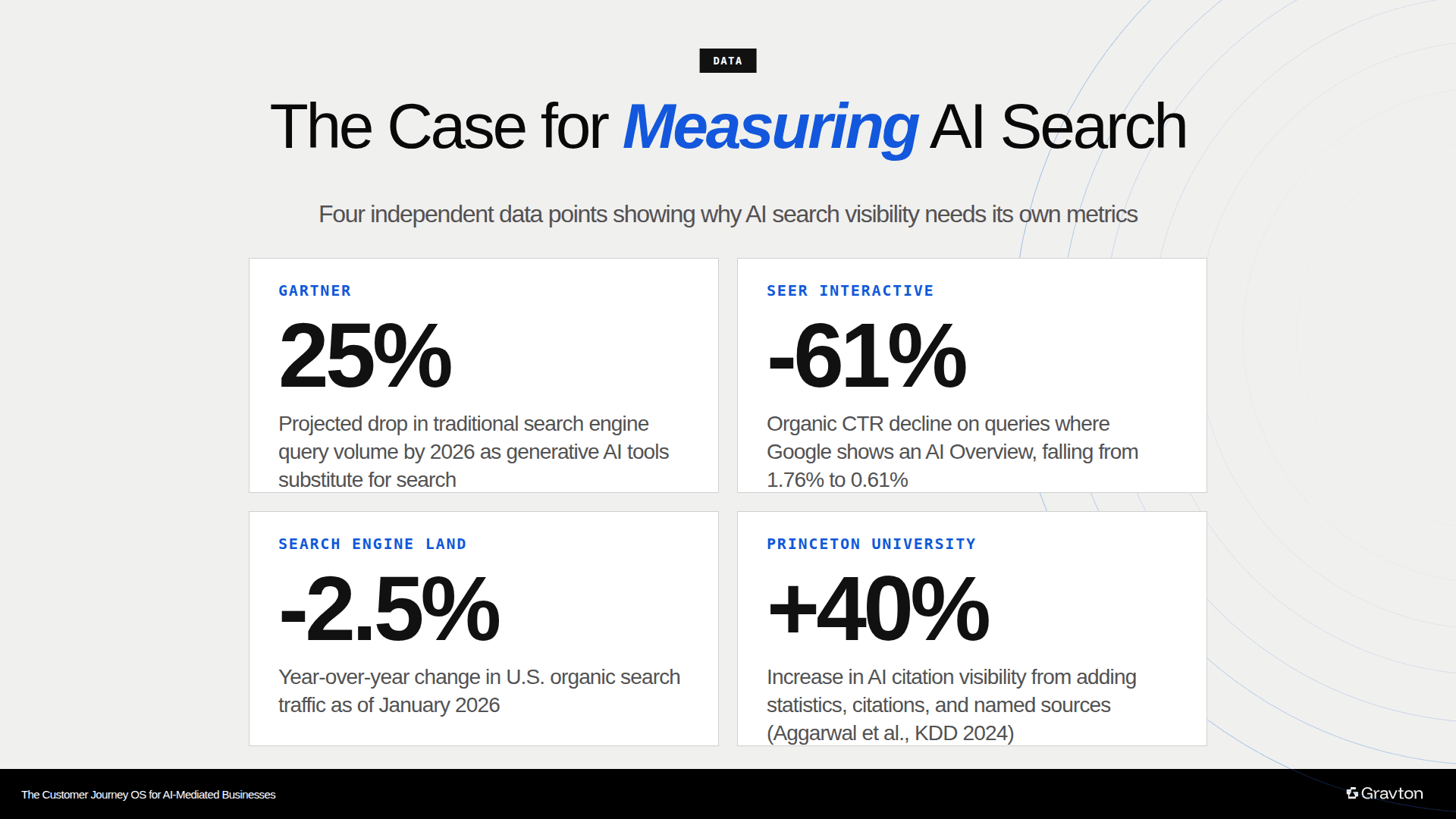
Figure 1: Why AI search visibility needs its own metrics, in four data points.
If you're not seeing your brand in AI answers at all yet, start with why your brand isn't showing up in ChatGPT before you worry about measurement. From there, understand where SEO ends and GEO begins, since the two require different metrics entirely.
The core AI search visibility metrics KPIs
Table 1: What are the core AI search visibility metrics KPIs and why they matter.
Metric | What it measures | Why it matters |
AI Visibility Score | Overall percentage of relevant prompts where your brand appears | Primary KPI for AI discoverability |
Prompt Coverage | % of tracked prompts where your brand is mentioned | Shows breadth of visibility |
Citation Rate | % of AI answers that cite your website or content | Indicates authority and trust |
Citation Share | Your share of all citations compared to competitors | Measures competitive authority |
Answer Inclusion Rate | Frequency your brand is included in recommendations | Tracks recommendation visibility |
Top Position Rate | % of answers where your brand is mentioned first | First mentions receive the most attention |
Share of Voice (SOV) | Your visibility versus competitors across prompts | AI equivalent of market share |
Brand Mention Accuracy | Whether AI describes your brand correctly | Prevents misinformation |
Sentiment Score | Positive, neutral, or negative portrayal | Measures reputation in AI answers |
Referral Traffic from AI | Visits originating from ChatGPT, Perplexity, Gemini, etc. | Connects visibility to website traffic |
Conversion from AI Traffic | Leads, signups, or sales generated from AI referrals | Business outcome metric |
Source Diversity | Number of unique sources AI uses when mentioning your brand | Reduces dependence on one source |
Owned vs. Third-Party Citation Ratio | Balance between citations from your site and external sources | Healthy authority comes from both |
Competitive Win Rate | % of prompts where you're mentioned instead of competitors | Tracks competitive performance |
Response Consistency | Whether AI gives similar answers across platforms and over time | Indicates stable brand understanding |
Together, these Generative search KPIs help measure whether your brand appears, earns citations, and outperforms competitors across AI-generated answers.
The takeaway
Building an AI search visibility strategy without AI visibility measurement and tracking AI search visibility metrics KPIs is optimizing blind. Track citation rate and share of voice weekly, review accuracy and sentiment monthly, and connect AI-referral traffic to conversions so the work ties back to the pipeline.
FAQs on AI search visibility metrics & KPIs
What are AI search visibility metrics?
AI search visibility metrics measure whether your brand appears in AI responses, how often it is cited, how accurately it is represented, and how it performs against competitors across platforms like ChatGPT, Perplexity, and Google AI Overviews.
Why do AI search visibility metrics matter?
Traditional SEO metrics like rankings, clicks, and impressions don't show whether AI systems recommend or cite your brand. AI search visibility metrics help measure your performance inside AI responses.
Which AI search visibility metrics should I track?
The core metrics include AI Visibility Score, Prompt Coverage, Citation Rate, Citation Share, Share of Voice, Brand Mention Accuracy, Sentiment Score, Referral Traffic from AI, and Competitive Win Rate.
How should AI search visibility metrics be measured?
A complete AI search analytics dashboard should combine three layers: visibility metrics tracked weekly, quality metrics reviewed monthly, and business metrics tied to AI referral traffic, conversions, and revenue.
Do AI search visibility metrics replace SEO metrics?
No. AI search visibility metrics complement SEO rather than replace it. Backlinks, crawlability, and domain authority still help AI systems find and trust your content, while AI visibility measurement shows how that content performs in generated answers.
VISIBILITY & CONTENT STRATEGY