
SaaS Prompts Before Demo: What Buyers Actually Ask an AI
SaaS Prompts Before Demo: What Buyers Actually Ask an AI
We measured 297 SaaS prompts before demo requests in one CRM category. Two mentioned a demo. Here is what buyers ask instead, and what it costs you.
Sagar Chouhan

SaaS Prompts Before Demo: What 297 Buyers Asked AI
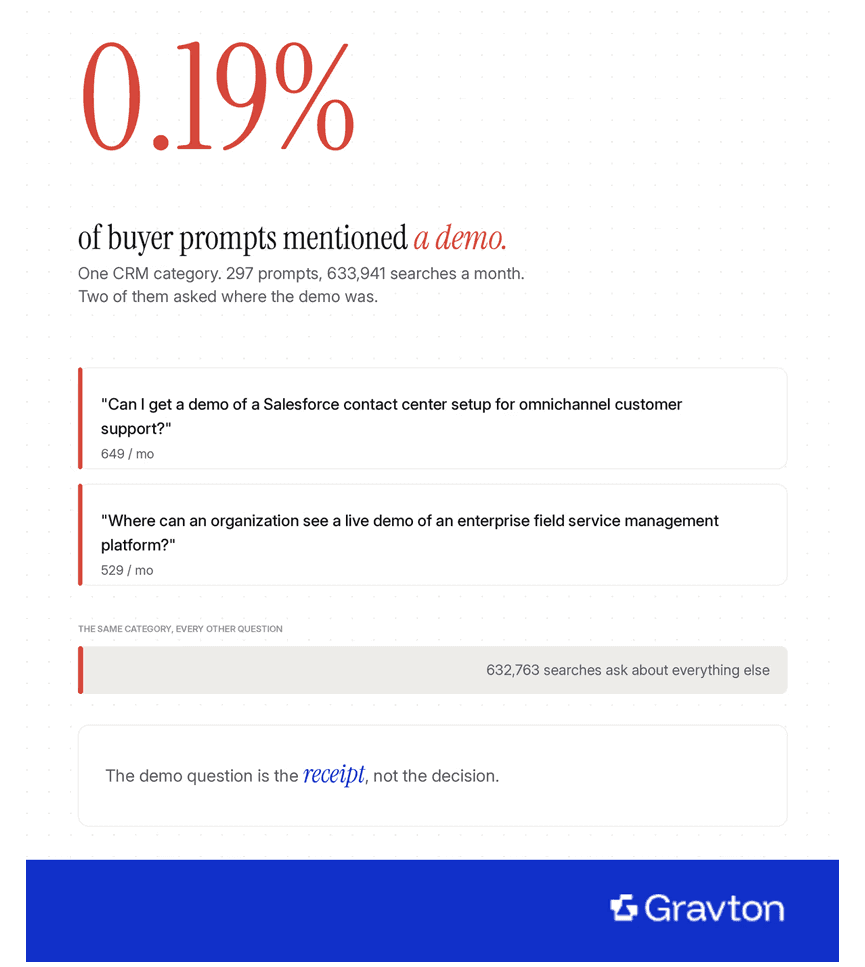
We tracked 297 SaaS prompts before demo requests across one CRM category on ChatGPT and Gemini. Two of them contained the word "demo." Together those two carry 1,178 searches a month out of 633,941. Everything else your buyers ask happens somewhere upstream, and most of it is not the question your content team is writing for.
Below: what these prompts are, why the demo barely appears, why prompt count misleads you, what decides whether you show up, and how to find your own set.
What Are SaaS Prompts Before Demo Requests?
They are the questions a software buyer types into an AI assistant while deciding, before any form gets filled. Category questions, comparison questions, pricing questions, and a large volume of operational questions about what owning the product is actually like. Taken together they are the full set of AI prompts for SaaS evaluation in a category, and they run far wider than the SaaS buyer questions most content plans account for.
GEO (Generative Engine Optimization) is the practice of optimizing content and source presence so a brand appears in AI-generated answers from large language models. A prompt set is where that work starts, because you cannot optimize for a question you have never seen. Prompt volume is how many times a month a question gets asked. Presence is the share of answers to that question where a given brand is named at all. Both matter, and most teams measure neither.
We ran every prompt in a fresh session, no branded context carried between them, and recorded which brands appeared and which pages the engines cited. The method and the wider category numbers are in our Q3 State of AI Search report.
Why Do Almost No Buyers Ask AI About Demos?
Because the demo is the outcome, not the research. The SaaS prompts before demo requests are where the work happens, and the demo question is the receipt at the end of it. Of 297 prompts, two mentioned a demo:
"Can I get a demo of a Salesforce contact center setup for omnichannel customer support?"
"Where can an organization see a live demo of an enterprise field service management platform?"
649 and 529 searches a month. Against a category total of 633,941, that is 0.19% of the demand.
By the time someone asks where the demo is, the decision is close to made. The questions that made it are the ones nobody counts. Gartner surveyed 646 B2B buyers and found they drew on seven information sources on average before deciding, with 45% using AI during the purchase. McKinsey's 2026 Global B2B Pulse, covering nearly 4,000 decision-makers across 13 countries, puts generative AI among buyers' top five channels for finding and evaluating suppliers.
Pew Research Center supplies the baseline underneath that. In a June 2026 survey of 5,119 US adults, 60% said they read the AI summary at the top of search results. People do not change habits when they get to work, and the habit shows up across ChatGPT, Perplexity and Google AI Overviews alike. Demo booking intent is the last 0.19% of that journey, not the whole of it.
Your demo request form is measuring the last step of a process you cannot see. We wrote about that gap in how AI search changes the SaaS buyer journey.
How Does Prompt Volume Differ From Prompt Count?
This is the finding that changed how we read our own data.
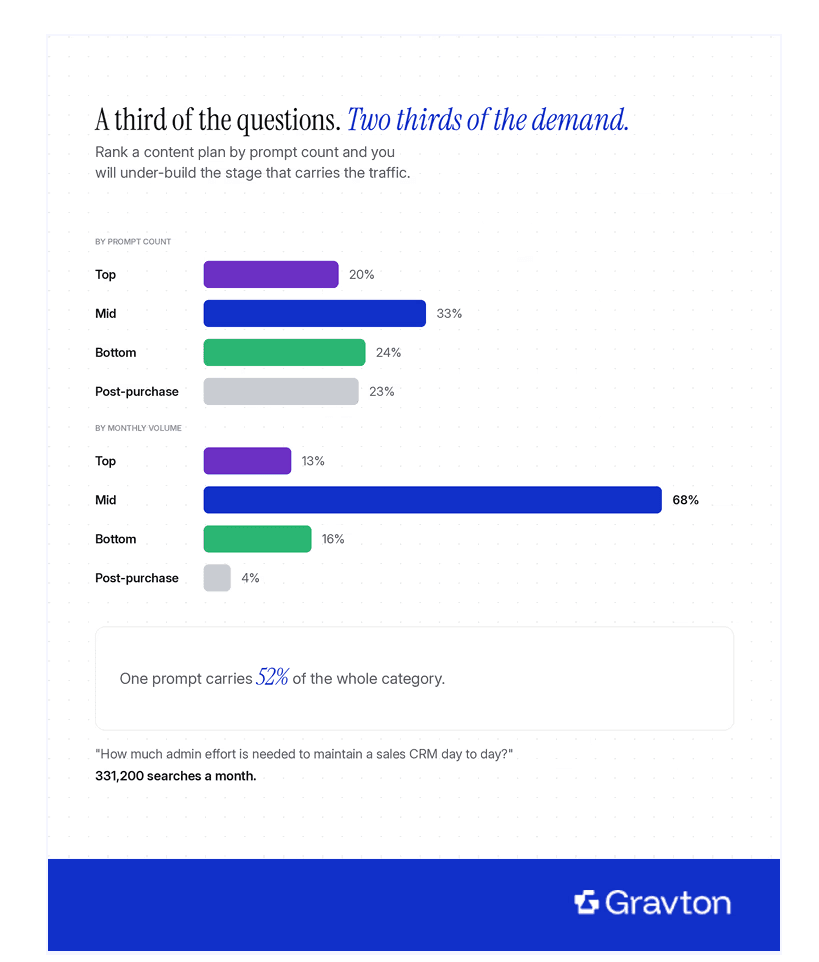
Counting prompts by funnel stage gives you one picture. Weighting them by monthly volume gives you a different one.
Funnel stage | Prompts | Share by count | Monthly volume | Share by volume |
|---|---|---|---|---|
Top | 60 | 20% | 80,424 | 13% |
Mid | 99 | 33% | 428,856 | 68% |
Bottom | 70 | 24% | 99,872 | 16% |
Post-purchase | 68 | 23% | 24,789 | 4% |
Total | 297 | 100% | 633941 | 100% |
Mid-funnel is a third of the questions and two thirds of the demand. Plan your content from the count and you will under-invest in the stage that carries most of the traffic by a factor of two.
One prompt does most of the work. "How much admin effort is needed to maintain a sales CRM day to day?" gets 331,200 searches a month on its own, 52% of the entire category. It is not a "best CRM" question. It is a buyer trying to find out what life is like after they sign.
What Decides Whether You Appear in Pre-Demo Answers?
Four things, in our data.
Source coverage, not page count. Across the same category we logged 8,423 citations, and roughly 90% pointed at pages no brand owns. Community threads and comparison content carry the answer.
Operational depth. The highest-volume prompts ask about admin burden, migration, integration and day-to-day maintenance. Product pages do not answer those. Documentation, forums and support content do.
Consistency across engines. The same 297 prompts produced different answers on ChatGPT and Gemini. ChatGPT ran query fanouts averaging 22 sources per answer. Gemini ran none across the whole test, answering from what it already held.
Specificity of the question. Broad category prompts favor whoever the engines already trust. Narrow operational prompts are winnable because almost nobody writes for them.
Freshness. Several of the highest-volume prompts in our set turn on pricing and packaging, which change. Stale pages get skipped even when they rank.
Classic tools measure a different object. Semrush and Google Search Console report pages and positions. Neither tells you which prompts your category gets, nor which page earned the LLM citation sitting behind a given answer.
Gartner also found 69% of buyers still turn to a sales rep to validate what the AI told them. The answer does not replace your sales team. It decides which sales team gets the call.
How Do You Find and Win Your Own Pre-Demo Prompts?
Four steps, in order.
Build the prompt set before writing anything. Write full questions the way a person types them, across all four stages. Ours ran to 297 for a single category. Our guide to prompt market analysis covers how to structure one.
Weight by volume, then by presence. Rank your prompts by monthly volume, then mark where you appear. The gap between high volume and low presence is your work queue, in priority order.
Write for the operational questions. The admin-effort prompt at 331,200 a month is answered by honest documentation about setup time and maintenance, not a features page. This is uncomfortable content to publish. That is why it is available.
Fix your presence on 3rd party surfaces. Since most citations are not yours, publishing more of your own pages moves the number slowly. Reviews, community answers and comparison placements move it faster.
What Does a Pre-Demo Visibility Gap Look Like?
A real one from the same dataset.
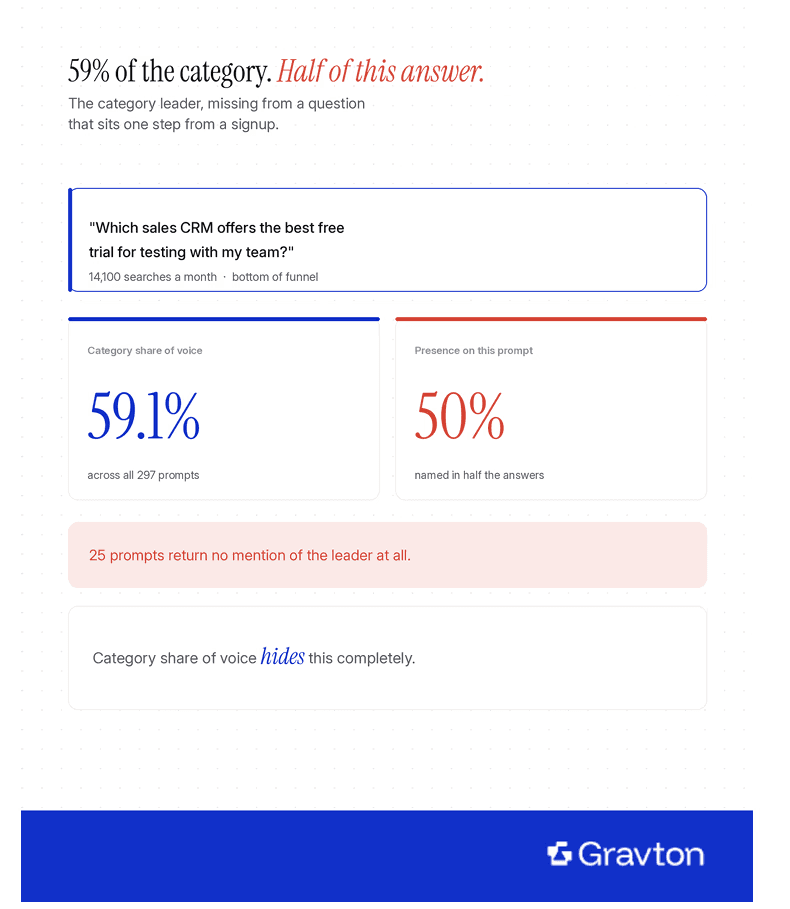
"Which sales CRM offers the best free trial for testing with my team?" gets 14,100 searches a month. It sits at the bottom of the funnel, one step from a signup. The category leader, which holds 59.1% share of voice across the whole category, appears in half the answers to that question.
Further down, "What is the best sales CRM for a small B2B sales team?" returns no mention of that leader at all. Across the set, 25 prompts return zero presence for a brand that dominates its category everywhere else.
A brand can hold most of the conversation and still be missing from the specific questions that sit closest to a purchase. Category-level share of voice hides that completely. You only see it prompt by prompt, which is what our B2B SaaS teams use the platform for.
How Do You Measure Pre-Demo Prompt Coverage?
Track four numbers on a fixed prompt set.
Coverage. The share of your prompt set where you appear at all.
Volume-weighted presence. The same figure weighted by monthly search volume. This is the honest one. Coverage flatters you when you win small prompts.
Stage balance. Your presence split across top, mid, bottom and post-purchase. Most teams are strongest where the volume is thinnest.
Citation ownership. What share of the pages cited in your answers you actually control. Ours ran under 10% for the category.
All four describe the invisible funnel: the pre-demo software research that never reaches your analytics. Treat the prompt set as the closest thing you have to a log of SaaS vendor evaluation happening in your category.
A note on the first two. Coverage and volume-weighted presence usually disagree, sometimes badly. A brand can appear in 60% of its prompts and still be missing from the handful that carry most of the demand. Report both or you will convince yourself things are fine.
Re-run on the same prompt set on a fixed cadence. Answers move between runs, so a single snapshot tells you almost nothing. Our notes on AI search metrics and KPIs go deeper on the definitions, and post-purchase AI visibility covers the 23% of prompts that arrive after the sale. One caveat worth stating plainly. This is one category, CRM, on two engines, over a June to July 2026 window. The shape of the finding has held everywhere we have looked, but the exact numbers are ours, not a law of nature.
The Demo Request Is the Receipt, Not the Decision
Two of 297 prompts asked about a demo. The other 295 decided whether that demo would ever be requested, and two thirds of the demand sat in mid-funnel questions about what the product is like to run.
Your form fills tell you the decision happened. They tell you nothing about where it was made. Build the prompt set. Weight it by volume rather than count. Then go and read the answers your buyers are already getting, because the SaaS prompts before demo requests are being answered right now, with or without you in them.
Free AI Visibility Audit, Limited Availability
Not sure how your brand is performing in AI search?
Gravton Labs is offering a free AI visibility audit for a limited number of businesses.
We will identify where your brand appears, and where it is missing, across ChatGPT, Perplexity, Google AI Overviews, and other leading AI platforms.
Claim your free audit at Gravton.ai
Q: What are SaaS prompts before demo requests?
A: They are the questions a software buyer asks an AI assistant while evaluating, before submitting a demo form. In our CRM study they covered category, comparison, pricing, and operational questions across all four funnel stages.
Q: Why do so few buyers ask AI about demos?
A: Because the demo is the outcome of the research, not part of it. Two of 297 prompts mentioned a demo, carrying 0.19% of the category's monthly volume.
Q: Which funnel stage carries the most AI search demand?
A: Mid-funnel. It was 33% of prompts by count but 68% by monthly volume in our CRM data. Ranking content plans by prompt count understates it badly.
Q: Can a market leader still be missing from pre-demo prompts?
A: Yes. The category leader in our dataset held 59.1% share of voice and still appeared in only half the answers to a 14,100-a-month free trial question, and none at all on 25 prompts.
Q: How many prompts do you need to track?
A: Enough to cover every stage and topic cluster in your category. Ours ran to 297 for CRM across seven clusters. Fewer than about 50 will not show you stage-level patterns.
Q: How is this different from keyword research?
A: Keywords are fragments. Prompts are full questions, and the same product can win a keyword while losing every prompt containing it. Presence replaces ranking as the unit of measurement.
Q: Should you write content for post-purchase prompts?
A: They were 23% of prompts but only 4% of volume in our set, so treat them as a retention and expansion play rather than an acquisition one.
Q: How often should a prompt set be re-run?
A: On a fixed cadence, monthly or quarterly, using the identical prompt list. AI answers are non-deterministic, so movement only means something when the input is held constant.
VISIBILITY & CONTENT STRATEGY