
The AI Search SaaS Buyer Journey | You Must Know
The AI Search SaaS Buyer Journey | You Must Know
The AI search SaaS buyer journey now starts inside ChatGPT and AI Overviews. See what changed, why it matters, and what marketing teams should fix first
Sagar Chouhan

The AI Search SaaS Buyer Journey: What Changed and Why
Your buyers are building a shortlist before they ever land on your website. The AI search SaaS buyer journey is the path a software buyer now takes through assistants like ChatGPT, Perplexity, and Google AI Overviews, where a model reads the web, picks sources, and hands back a short answer naming a few vendors. The change is simple to state and hard to fix: discovery moved from a page of links you could rank on to a single answer you either appear in or you do not.
Below: what the new journey looks like, why it changes your pipeline math, what decides which brands get cited, the methods that work, a worked example, and the metrics to track.
"Visibility in AI is not a top-of-funnel awareness play. It is the new first stage of a revenue funnel that companies have not yet learned to measure or act on."
Tarun Babbar, Founder and CEO, Gravton Labs
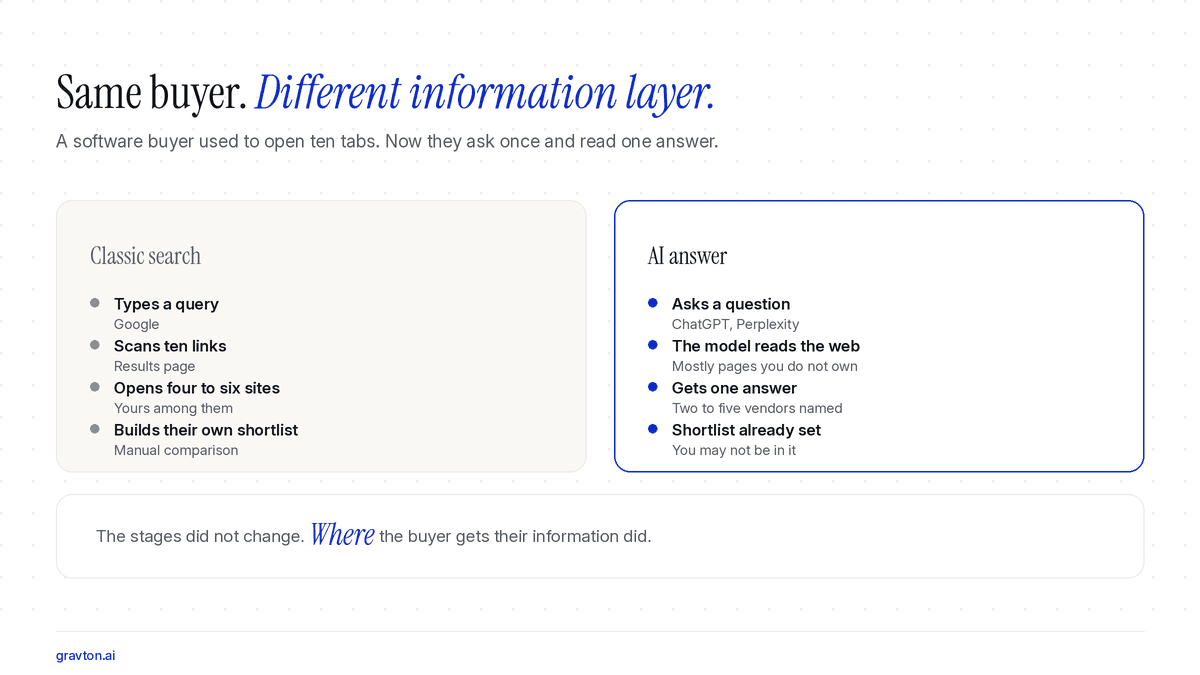
AI search SaaS buyer journey compared with the classic search funnel for software buyers
What Is the AI Search SaaS Buyer Journey?
It is the sequence of research, comparison, and shortlisting steps a B2B software buyer completes with help from AI answer engines instead of, or alongside, a search results page.
Two terms matter here. GEO (Generative Engine Optimization) is the practice of optimizing content and source presence so a brand appears in AI-generated answers from large language models. AI visibility is the measurable share of those answers where a brand is named, described, or cited.
The mechanics differ from search in one important way. A search engine gives the buyer 10 links and lets them decide. An answer engine reads dozens of pages, most of which the brand does not own, and returns a verdict. The buyer sees three vendors and a summary of each, not a page they can scroll.
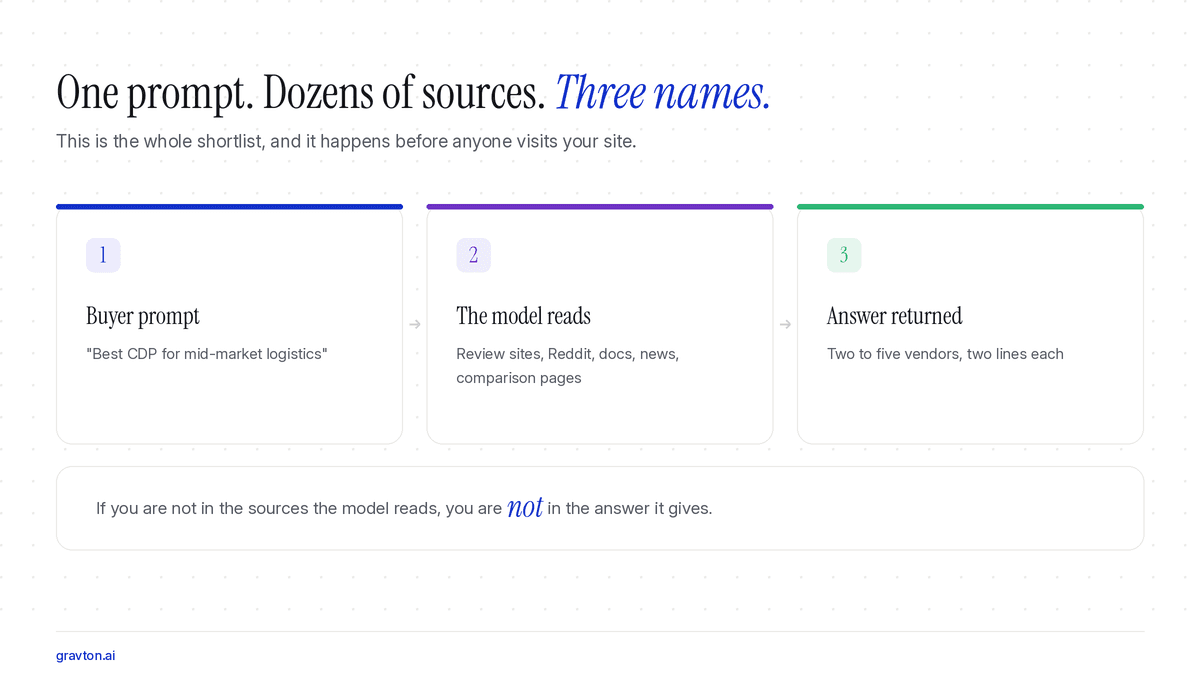
AI search vendor shortlisting process showing how one buyer prompt becomes a curated list of recommended SaaS vendors.
Why Does the AI-Powered Buyer Journey Matter for Revenue?
Because the shortlist forms earlier, and you are not in the room when it does.
The behavior is already mainstream. Pew Research Center found in June 2026 that 60% of US adults say they read AI summaries at the top of search results, and that 49% now use AI chatbots, up from 33% in 2024. Buyers do not switch personas when they get to work.
On the B2B side, Gartner surveyed 646 B2B buyers and found 45% used AI during a recent purchase. The same research program found buyers drew on an average of seven information sources per purchase, and 67% said they prefer a rep-free experience.
McKinsey's 2026 Global B2B Pulse, covering nearly 4,000 decision-makers across 13 countries, puts generative AI in buyers' top five channels for supplier discovery and evaluation, next to supplier websites, in-person meetings, web search, and video calls. Buyers in that study used an average of 10 channels across a purchase.
Two more numbers matter. McKinsey found 73% of buyers are now comfortable placing orders above $50,000 online, up from 59% in 2022. And inconsistent information across teams is now the number one reason buyers switch suppliers. If a model reads three different versions of your positioning across your site, a review platform, and a partner page, that inconsistency is now visible at the exact moment a buyer is choosing.
Call this the invisible funnel: real B2B SaaS buyer intent that never touches your analytics because the research happened inside an AI answer. Our founder makes the same argument in visibility as the first stage of the revenue funnel.
How Does AI-Assisted Software Discovery Differ From the Classic SaaS Buying Process?
The stages have not changed much. Where the buyer gets their information has changed completely.
Stage | Classic SaaS buying process | AI-powered buyer journey |
|---|---|---|
Problem framing | Google query, blog posts, peer chatter | Conversational prompt, model summarizes the category |
Category learning | Analyst pages, vendor sites, webinars | AI-generated answer built from 3rd party sources |
Shortlist creation | Comparison pages, G2 and Capterra, referrals | Model names two to five vendors in one response |
Evaluation | Vendor site, pricing page, demo request | Follow-up prompts on pricing, integrations, and objections |
Validation | Reviews, references, sales conversation | Reviews plus a rep call to check what the AI said |
Visible to your analytics | Mostly yes | Mostly no, until the buyer arrives ready to talk |
Buyers still want a human at the end. Gartner found 69% turn to sales reps to validate AI-generated insights. The AI does not remove your sales team. It decides which sales teams get the call.
What Principles Decide Whether AI Models Cite Your Brand?
Five principles hold across ChatGPT, Perplexity, and Google AI Overviews.
Entity clarity. Models need to know what you are, who you serve, and what category you belong to. Vague positioning gets you left out of category answers.
Source coverage beats page count. Most citations in AI answers point to sites you do not own: review platforms, Reddit, YouTube, news, and comparison articles. Your blog alone will not carry the answer.
Structured, extractable content. Clear definitions, direct answers, and short factual sentences are easier for a model to lift than narrative marketing copy.
Freshness and consistency. Conflicting or stale claims across your owned and 3rd party surfaces weaken the confidence a model has in citing you.
Prompt coverage, not keyword coverage. Buyers ask questions, not keywords. The unit of demand is a prompt.
Tools such as Semrush and Google Search Console still tell you about classic search. They do not tell you which prompts your buyers ask or which sources the model read to answer them.
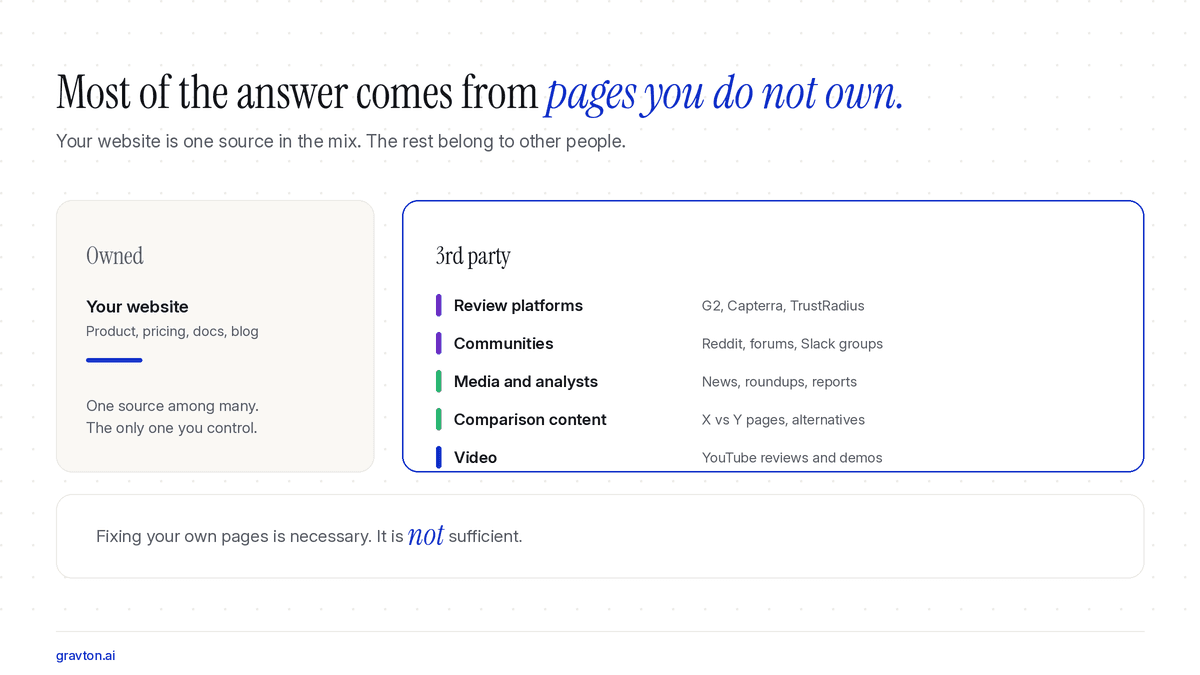
AI search relies on third-party sources such as review platforms, communities, analysts, and comparison websites more than owned content.
How Do You Win Visibility in Generative AI Search for SaaS?
Work the problem in four steps.
Map the prompt universe. List the questions your buyers actually ask across problem, category, comparison, and objection stages. Run them against each engine and record what comes back. This is the baseline. A free AI visibility audit is the fastest way to get one.
Find where competitors intercept you. Note which brands appear in answers where you are absent, and which sources those answers cite. Competitor interception on a comparison prompt is a direct pipeline problem, not a branding one.
Fix the source layer, not only the site. If Reddit threads, review platforms, and analyst pages dominate the citations for your category, your work sits there. Owned pages should answer questions directly, define terms on first use, and stay current. Our guide to generative engine optimization covers the on-page side, and our breakdown of citation graphs and source influence covers the off-site half.
Rebuild the sales handoff. Buyers arrive with a model's summary of your product in their head, right or wrong. Give your reps the current AI answer for your top prompts so they can correct it. See our notes on GEO compared with SEO for where the two disciplines split.
What Does an AI-Mediated Shortlist Look Like in Practice?
Here is an illustrative scenario, not a client result.
A VP of Marketing at a 400-person logistics company needs a customer data platform. She opens ChatGPT and types: "best customer data platform for mid-market logistics companies." The model returns three vendors with two lines each. She follows up: "which of these handles EU data residency?" One vendor drops out. A third prompt on pricing transparency removes another.
She has a shortlist of two and has not visited a single vendor site. A fourth vendor, well ranked on Google for "customer data platform," never appeared, because the sources the model pulled from were a G2 category page, two Reddit threads, and an industry publication roundup. That vendor's absence never showed up in its analytics. It simply received fewer inbound demos that quarter and had no way to explain the drop.
That is the invisible funnel doing its work. We documented a real version of this pattern in our case study on a B2B SaaS platform with 400 blog posts that was invisible to AI search on 68% of buyer queries. You can map the same thing for your own category.
How Do You Measure the AI Search SaaS Buyer Journey?
Classic SEO metrics do not transfer. Track these instead.
Presence rate. The share of your tracked prompts where your brand appears at all.
Share of voice. Your mentions as a percentage of all brand mentions across those answers.
Citation source mix. Which domains the model cites, split by owned, 3rd party, review, community, and competitor sources.
Competitor interception rate. Prompts where a competitor appears and you do not.
Sentiment and accuracy. What the model says about you, and whether it is correct.
Engine variance. The same prompt answered by ChatGPT, Perplexity, and Google AI Overviews often produces different vendors. Track each separately.
Measure on a fixed prompt set and a fixed cadence. Answers change between runs, so a single snapshot tells you very little. Our guide to measuring ROI from GEO explains how to set the baseline, and our B2B SaaS solution overview covers the reporting side.
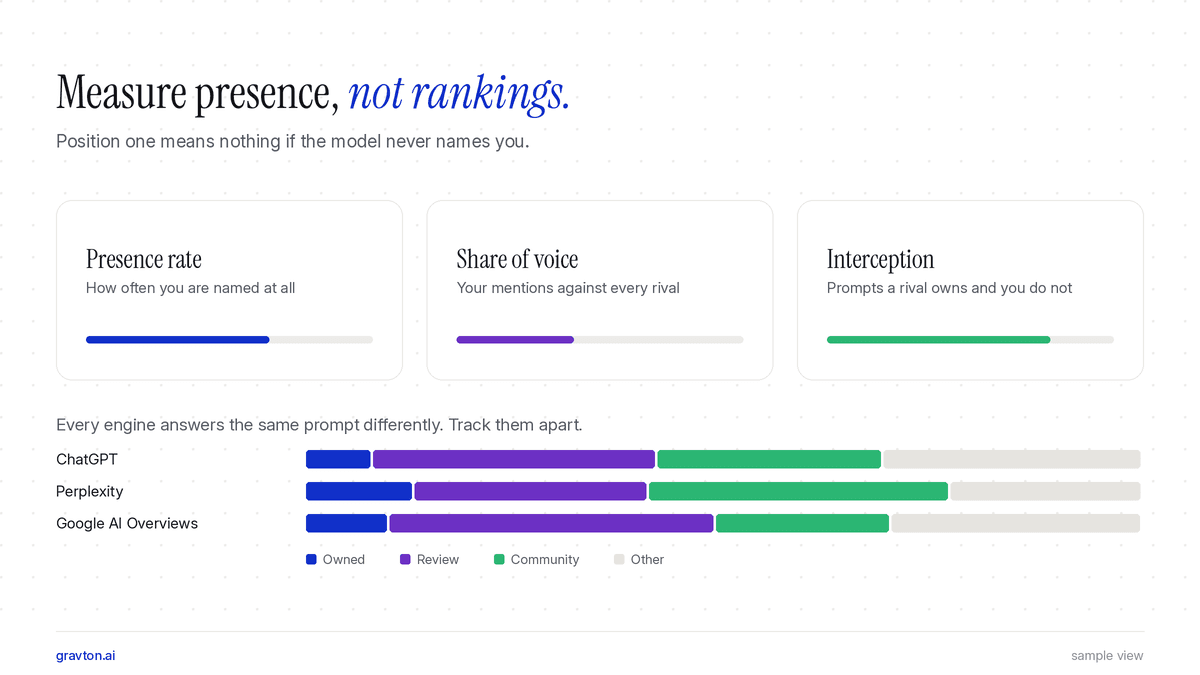
AI search visibility metrics including presence rate, share of voice, and competitor interception across ChatGPT, Perplexity, and Google AI Overviews.
The Shortlist Forms Before the First Click
The buying stages are familiar. The information layer is not. Buyers now ask a model, get a short answer naming a few vendors, and arrive at your sales team with that answer already formed. Gartner, McKinsey, and Pew all point the same direction: AI-assisted research is a standard part of the B2B SaaS buyer intent path, not an edge case.
The practical takeaway is that your visibility problem starts outside your website. If you cannot see which prompts your category gets, which sources the models read, and where competitors take your place, you are managing a funnel you cannot see. Start by measuring it.
Free AI Visibility Audit, Limited Availability
Not sure how your brand is performing in AI search?
Gravton Labs is offering a free AI visibility audit for a limited number of businesses.
We will identify where your brand appears, and where it is missing, across ChatGPT, Perplexity, Google AI Overviews, and other leading AI platforms.
Claim your free audit at Gravton.ai
Q: What is the AI search SaaS buyer journey? A: The AI search SaaS buyer journey is the research and shortlisting path a B2B software buyer takes through AI answer engines such as ChatGPT, Perplexity, and Google AI Overviews, where a model summarizes the category and names a few vendors instead of returning a list of links.
Q: Why does AI search matter for B2B SaaS marketing teams? A: Because the shortlist forms before the buyer visits your site. Gartner found 45% of B2B buyers used AI during a recent purchase, and McKinsey places generative AI among buyers' top five discovery channels.
Q: What is the invisible funnel? A: The invisible funnel is buyer research that happens inside AI-generated answers and never appears in your analytics. You see the outcome, fewer or more inbound conversations, without seeing the cause.
Q: How is Generative Engine Optimization different from SEO? A: SEO optimizes for ranking positions on a results page. GEO (Generative Engine Optimization) optimizes for being retrieved and cited inside an AI-generated answer, which depends heavily on 3rd party sources you do not control.
Q: Can you influence which sources an AI model cites? A: Partly. You can improve your owned pages, correct inaccurate 3rd party listings, and build presence on the review platforms, communities, and publications that models pull from most in your category.
Q: Do buyers still talk to sales reps in an AI-assisted software discovery process? A: Yes. Gartner found 69% of B2B buyers turn to sales reps to validate AI-generated insights, even though 67% say they prefer a rep-free experience.
Q: How should you measure AI visibility? A: Track presence rate, share of voice, citation source mix, competitor interception, and answer sentiment across a fixed prompt set, measured separately for each engine on a regular cadence.
Q: How long does it take to change AI search visibility? A: It varies by category and by how much of the citation base you already hold. Set a baseline first, then remeasure on the same prompt set so you can tell real movement from normal answer variance.
VISIBILITY & CONTENT STRATEGY