
E-E-A-T for AI Search: What It Means and Why It Decides Citations
E-E-A-T for AI Search: What It Means and Why It Decides Citations
Understand how AI models evaluate Experience, Expertise, Authoritativeness, and Trustworthiness (E-E-A-T) for AI search and how to improve AI citations.
Haritha Kadapa

Highlights
E-E-A-T (Experience, Expertise, Authoritativeness, and Trustworthiness) is the framework AI search engines use to determine whether your content is reliable enough to cite.
Experience: Demonstrate first-hand knowledge through case studies and practical insights.
Expertise: Showcase subject-matter knowledge with qualified authors, accurate information, and in-depth content.
Authoritativeness: Build recognition through backlinks and citations or mentions from trusted industry sources.
Trustworthiness: Strengthen credibility with verifiable data, transparent sourcing, and regularly updated content.
What is E-E-A-T for AI search?
Your content can be accurate and still lose an AI citation to a competitor. One reason is that AI search systems need signals that help them assess whether a source is reliable and worth using.
E-E-A-T stands for Experience, Expertise, Authoritativeness, and Trustworthiness.
Initially, Google built the framework to rank web pages. E-E-A-T is Google's framework for thinking about Experience, Expertise, Authoritativeness, and Trustworthiness in content quality. AI search systems have their own retrieval and ranking systems, so E-E-A-T should be treated as a useful framework for building credible content, not as a confirmed ranking factor shared by every AI platform.
E-E-A-T for AI search optimization measures whether a piece of content shows firsthand experience, subject-matter depth, recognized authority, and verifiable AI trust signals before a model treats it as a reliable answer.
Unlike a ranking factor buried in an algorithm, E-E-A-T signals show up directly inside a generated response. Either your brand gets named, or a competitor does.
Why do AI models rely on E-E-A-T signals?
AI systems need ways to identify useful and reliable information when retrieving sources. Google, for example, advises publishers to demonstrate experience, expertise, authoritativeness, and trustworthiness when creating helpful, reliable content.
For AI search, the practical lesson is similar but should not be overstated: named authors, clear sourcing, specific evidence, and a consistent record of expertise can make a piece of content easier to assess and understand.
Because of this, two pages with identical facts can produce very different outcomes in AI search visibility.
When important credibility signals are missing, a source may be harder to evaluate against competing sources.
Who decides which AI E-E-A-T signals count?
No single company sets the standard. ChatGPT, Perplexity, Gemini, and Google AI Overviews each run their own retrieval and ranking logic.
However, the same four concepts provide a useful framework for thinking about content credibility, even though individual AI platforms use different systems to retrieve and rank sources.
In simple terms, your subject-matter experts, your legal team, and your content team all shape these signals. A post with no named author, no supporting data, and no mentions from other credible sites sends weak AI trust signals.
How do you build E-E-A-T signals a model can cite?
Start with the four signals separately. Show experience through original examples and first-hand observations, expertise through qualified authors and accurate explanations, authority through credible third-party mentions, and trust through transparent sourcing, clear dates, and verifiable claims.
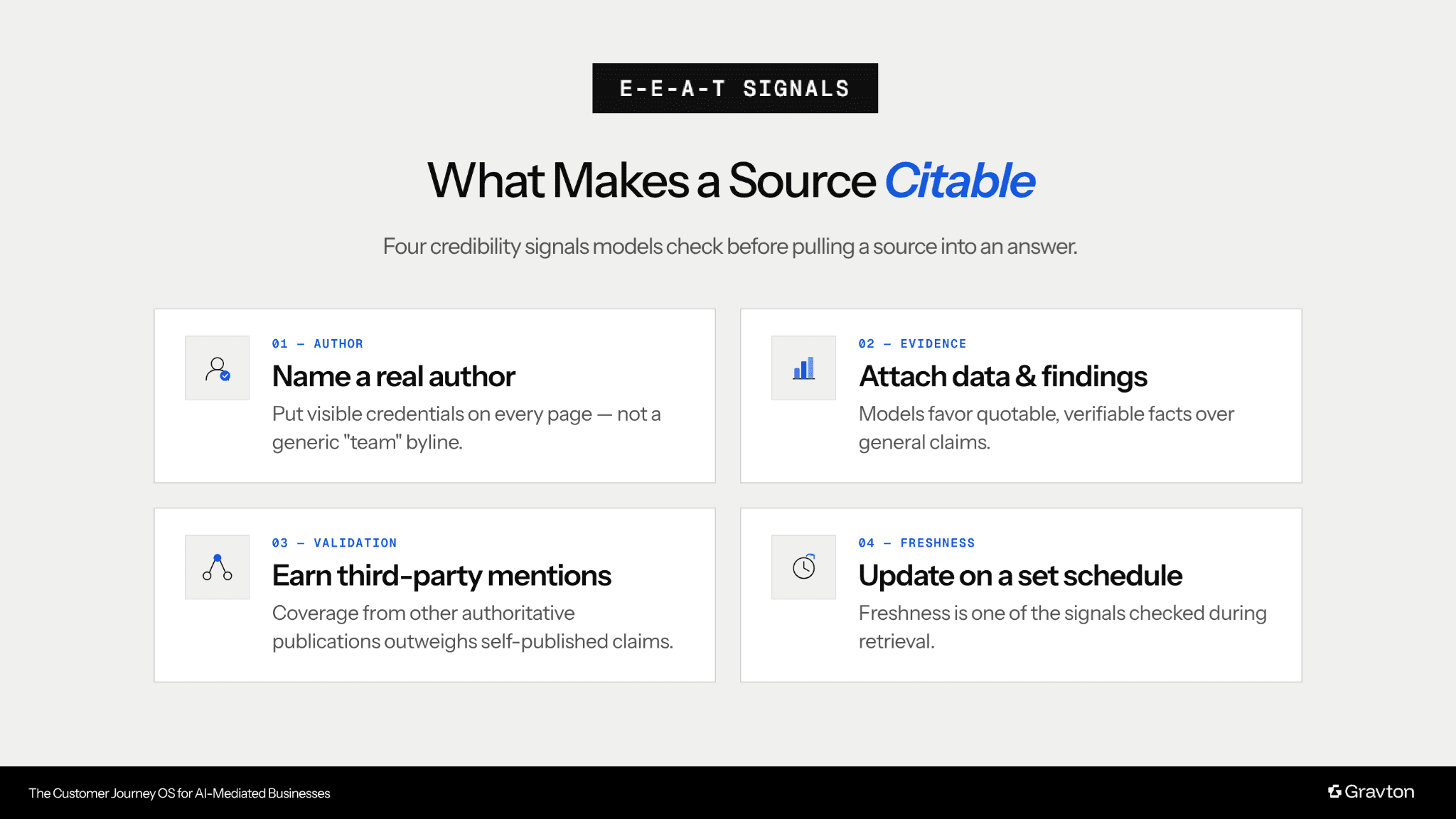
Figure 1: E-E-A-T signals.
Gravton's Content Studio builds pages around this structure from the first draft and checks them against existing content before they go live.
Where does Gravton fit into E-E-A-T for AI search?
Gravton's Insights Engine tracks whether AI systems already treat your brand as an authoritative source.
Then, our Opportunity Engine flags which specific E-E-A-T gaps are costing you citations against named competitors.
Combined with Gaps and Opportunities, this turns E-E-A-T from a one-time checklist into a score you can track, the same way Gravton tracks AI search visibility across ChatGPT, Perplexity, and Gemini.
|
When should you audit your E-E-A-T signals?
First, audit E-E-A-T signals before every content push.
Then, run a second audit the moment a competitor starts appearing more often in AI responses for your core topics. That shift is a direct sign their E-E-A-T signals now outweigh yours in the model's ranking logic, and it's the clearest trigger to act on.
E-E-A-T for AI search engines isn't a settings toggle you switch on once. It's a set of signals that either strengthens or weakens every time you publish, and the brands that treat it as ongoing infrastructure are the ones that keep showing up in AI responses.
FAQs on E-E-A-T signals in AI search
What is E-E-A-T for AI search visibility?
E-E-A-T stands for Experience, Expertise, Authoritativeness, and Trustworthiness. AI systems use these signals to decide whether your content is reliable enough to cite.
How can E-E-A-T principles improve content for AI search?
Use signals such as named authors, subject-matter expertise, supporting evidence, credible third-party mentions, and regularly updated information to make content easier to assess and trust. Individual AI platforms may weigh these signals differently.
How can I improve E-E-A-T for AI search?
Use real authors with visible credentials, include original data and examples, earn mentions from authoritative sources, and keep content updated.
When should I audit E-E-A-T signals?
Audit E-E-A-T before every content push and whenever competitors begin appearing more often in AI responses, as this signals their E-E-A-T may now outweigh yours.
Find your AI search visibility gaps
See which questions surface your brand, which ones send buyers to competitors, and where your content has visibility gaps.
VISIBILITY & CONTENT STRATEGY