
Does Schema Help AI? A Straightforward Answer
Does Schema Help AI? A Straightforward Answer
Does schema markup help AI? Yes. It helps ChatGPT, Perplexity, and Gemini understand and cite your content accurately. Here's how to use it well.
Haritha Kadapa

Highlights
Schema removes guesswork: It tells search systems exactly what a page is, instead of leaving them to infer it from context.
Not all schema types are equal: Article, FAQPage, HowTo, and Organization are different structured data types, each designed to describe a different kind of content or entity.
Placement matters: Blog posts, Q&A sections, tutorials, and homepages each call for a different schema type, matched to what's actually on the page.
Structured content wins the most: B2B brands, product catalogs, and long-form guides see the clearest gains, since AI models pull those directly for buyer questions.
Schema has limits: It labels content clearly but can't fix weak writing, add missing facts, or guarantee a citation over a stronger competitor.
Does schema help AI? A straightforward answer is yes, but not in the way many marketers assume.
Schema markup gives search systems structured information about what a page contains. It can reduce ambiguity around things such as the page type, author, organization, or other entities described on the page.
But schema is not a shortcut to AI citations. It does not guarantee that ChatGPT, Perplexity, Gemini, or another AI system will select your content over a competitor.
This article breaks down what schema is, why it matters for large language models (LLMs), and how to use it well.
Q: What is schema markup?
Schema markup is a standardized vocabulary of tags you add to your website's code. It tells search engines and AI systems exactly what a piece of content is: an article, a product, a recipe, a question and answer.
The most common format today is JSON-LD schema, a block of structured data written in JSON and placed in the page's <head> section. It sits behind the scenes. Visitors cannot see it, but crawlers and AI models read it.
Schema.org maintains the shared vocabulary used to describe these entities and relationships across the web.
Structured data SEO has been around for over a decade, built mainly for Google's rich results. Google also makes clear that structured data does not guarantee that a page will receive a particular search appearance. What has changed is who else reads it: ChatGPT, Perplexity, Gemini, and other AI systems now parse the same tags to figure out what your page says.
Q: Why does schema help AI understand your content?
Schema helps AI because it removes interpretation. Without it, a model has to infer what a page is about from surrounding text, layout, and context clues. With schema, the answer is stated directly in machine-readable form.
Here is a simple example. A blog post about "the best CRM tools" could be a review, a listicle, or an opinion piece. An article or Product schema tag removes that guesswork immediately. The model does not need to interpret; it can read the label.
This is the core reason schema for LLMs matters. AI models are built to extract facts quickly and reuse them in answers. Content that states its own structure gets extracted with less risk of misreading. That is the honest version of "does schema help AI."
Q: How does schema markup work for LLMs?
Schema for LLMs works by mapping your content to defined types from schema.org, a shared vocabulary used across the web. When an AI crawler visits your page, it reads these tags alongside your visible text.
Some schema types matter more than others for AI search optimization:
Article: labels a page as editorial content with an author, headline, and publish date.
FAQPage: formats question-and-answer content the way AI models often generate answers.
HowTo: breaks a process into ordered steps, which AI systems can extract and summarize directly.
Organization: establishes your brand as a defined entity, not just a domain name.
Each type gives the model a shortcut. Instead of parsing loose paragraphs to guess what a section does, the model reads the tag and knows.
The key is that the markup needs to describe what is actually present on the page accurately. It is recommended to use structured data that represents the visible content and not to add structured data that does not match the page.
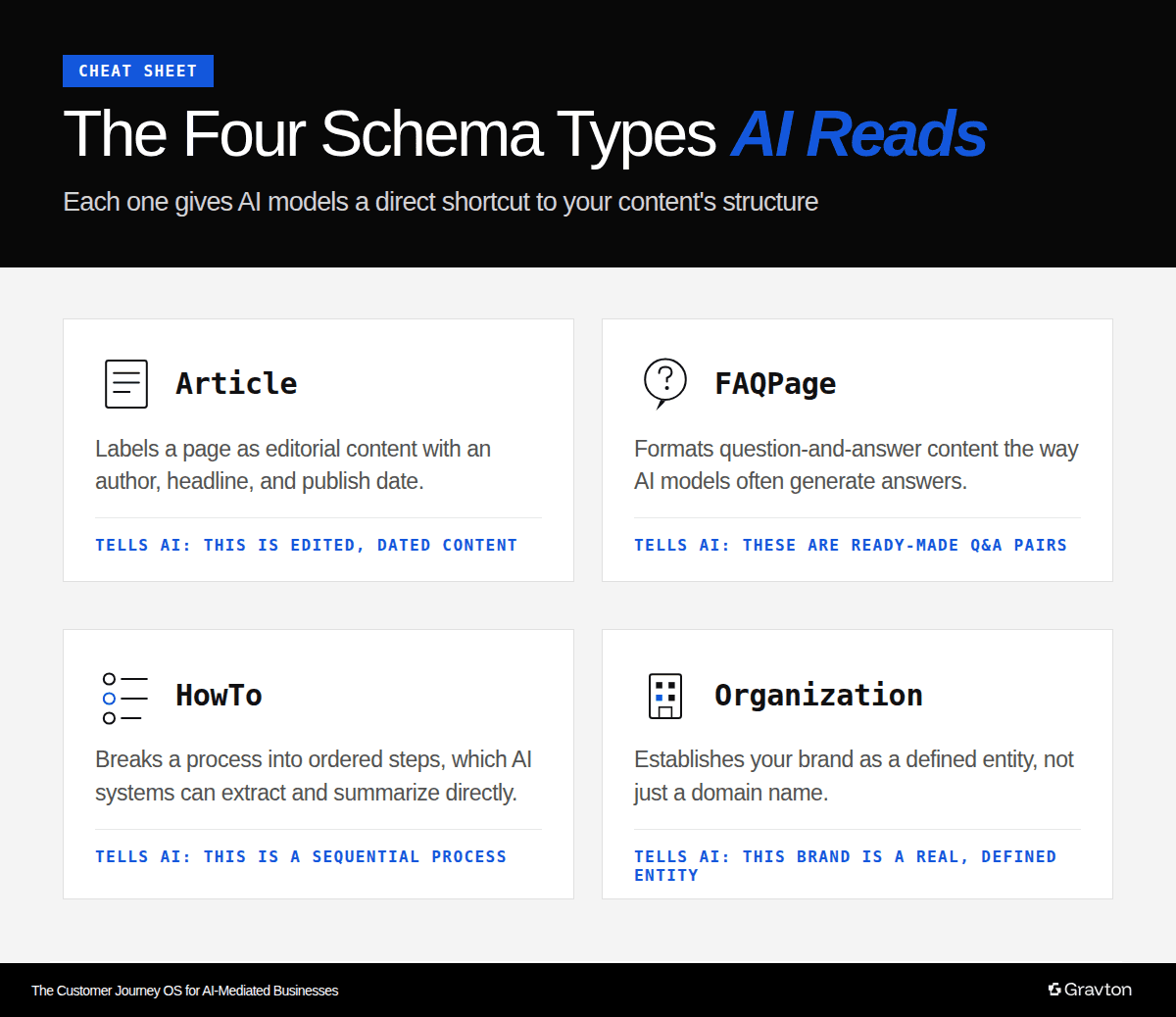
Figure 1: The four types of schema.
This is also why schema markup for AI pairs so well with clean, well-structured content; the tags and the text need to say the same thing.
Q: Where should you add a schema on your site?
Add schema to any page you want an AI model to cite with confidence. In practice, that means:
Blog posts and guides: use Article schema with complete author and date fields.
Question-and-answer sections: use FAQPage schema, so answers stay intact when extracted.
Step-by-step content: use HowTo schema for tutorials or processes.
For your homepage and about page: use Organization schema to define your brand as an entity.
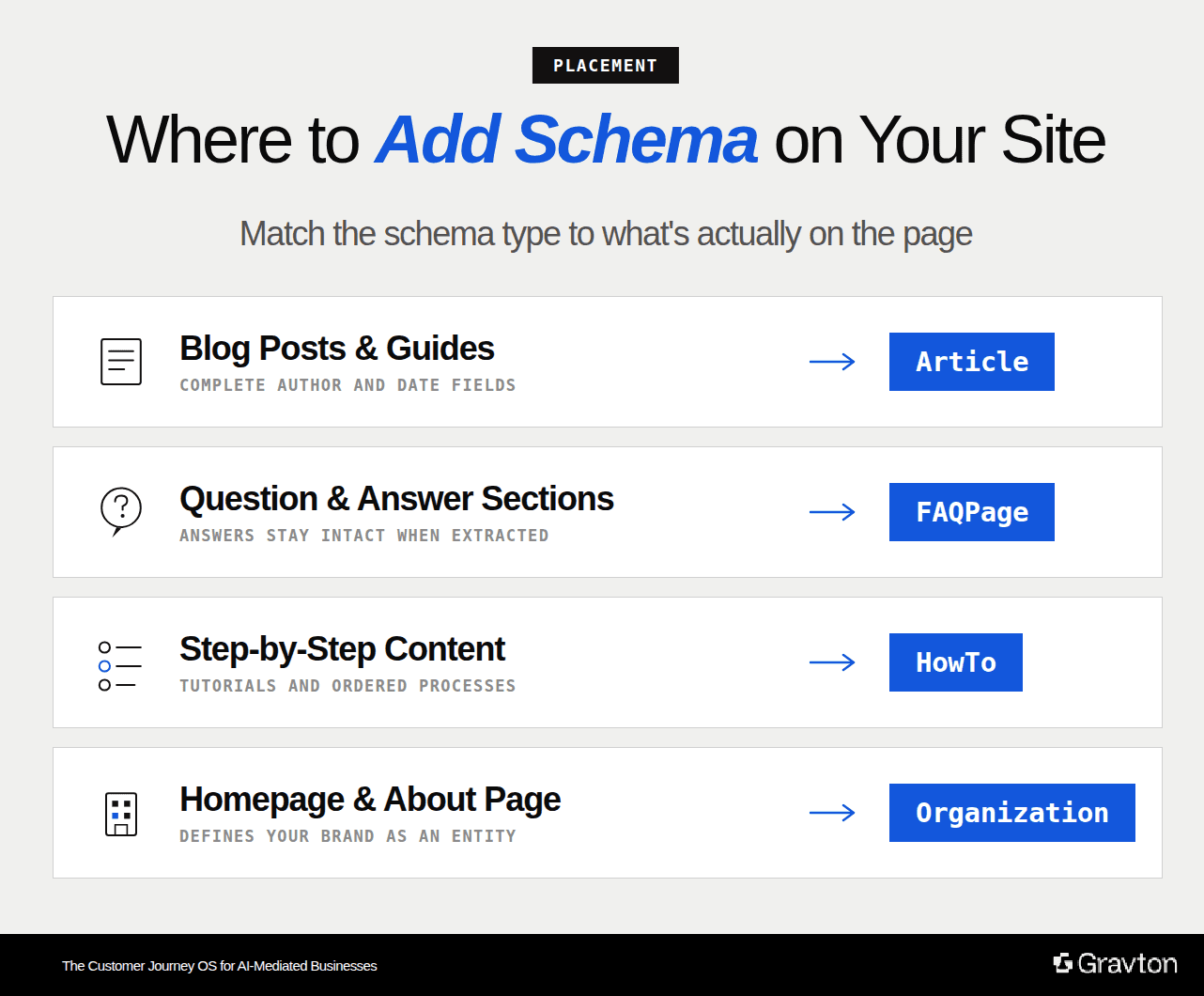
Figure 2: Where to add schema on a site?
Schema only helps if it matches what is actually on the page. Mismatched schema tags that claim one thing while the visible content says another can confuse crawlers and weaken trust in your site. Keep the structured data aligned with the visible content, and validate your markup regularly with an appropriate testing tool.
Q: Who benefits most from schema markup for AI?
Any brand competing to be cited in AI search, and sites with a lot of structured information, including product catalogs, help centers, comparison content, and long-form guides.
B2B companies see a clear gain, because this structured content is exactly what AI models pull from when answering buyer questions. But schema should be treated as supporting infrastructure rather than a standalone AI visibility strategy.
If your team is tracking how often your brand shows up in AI answers, schema is one of the more direct levers you can pull, alongside monitoring AI search visibility, content quality, relevance, authority, and citation patterns.
Q: When does schema markup not help?
Schema will not fix weak or vague content. It labels what is already there; it does not improve writing quality, add missing facts, or make thin content more citable.
Schema markup also cannot force an AI model to select your page over a stronger competitor.
Adding more schema types is not automatically better. The markup should describe information that actually exists on the page.
Think of schema as clarity. It answers "what is this page?", not "why should this page be trusted?" Authority signals, accurate information, and consistent brand presence still carry that weight.
For a fuller picture, see How to build an AI search visibility strategy?
Gravton's view
Gravton treats schema as infrastructure. Our Content Engine checks whether your structured data actually matches what a page says, then flags mismatches before they cost you a citation.
Our Insights Engine shows which of your pages are already being read and cited by AI systems, and our Opportunity Engine points to where missing or incomplete schema is likely holding a page back from gaps and opportunities you're not capturing yet.
When it is time to fix a page, Content Studio also helps you rebuild it with the structure AI models expect.
You can read more about how we approach this in Gravton's AI search visibility tracking.
What should you do next?
Start with your highest-traffic pages. Add or correct Article, FAQPage, HowTo, or Organization schema where it applies, and confirm the tags match the visible content. This one change gives AI crawlers a clearer read of your site and reduces the odds of being misunderstood or skipped.
Does schema help AI? Yes, reliably and measurably, as one part of a larger AI search optimization strategy. It is not the whole strategy, but it is a foundation you should not skip.
FAQs on schema markup for AI
Does schema markup actually help AI models cite my content?
Yes. It reduces ambiguity by telling AI systems exactly what a page is, which lowers the risk of misreading or skipping it.
Which schema types help AI the most?
Article, FAQPage, HowTo, and Organization schema are among the most useful for AI. Each one tells AI exactly what kind of content is on the page, making it easier to extract and understand information.
Does schema guarantee AI citations?
No. Schema helps AI understand your content more accurately, but it does not guarantee a citation. Content quality, authority, and relevance still determine whether an AI model chooses your page.
Where should I add a schema on my website?
Add schema to pages you want AI models to understand and cite with confidence, such as blog posts, guides, question-and-answer pages, tutorials, your homepage, and your about page. Always make sure the schema matches the visible content.
Can schema improve poor-quality content?
No. Schema labels content clearly, but it cannot improve weak writing, add missing facts, or make thin content more trustworthy. It works best when combined with accurate, well-structured, and authoritative content.
Find your AI search visibility gaps
See which questions surface your brand, which ones send buyers to competitors, and where your content has visibility gaps.
VISIBILITY & CONTENT STRATEGY