
What is Search Intent vs AI Intent: What Changed and Why It Matters
What is Search Intent vs AI Intent: What Changed and Why It Matters
Search intent ranks keywords; AI intent interprets the full meaning of a prompt. See how they differ and what it means for your content strategy.
Haritha Kadapa

Highlights
Search intent vs AI intent are different systems: Search intent classifies a keyword for ranking. AI intent interprets a full prompt's meaning to generate a direct answer.
Query intent evolution changed what a query carries: Prompts now hold buyer stage, constraints, and context in one line, information a short keyword never captured.
Informational intent in AI search rewards citability, not clicks: Content now competes to be one of the few sources an AI model quotes from, not the page a user clicks through to.
E-E-A-T signals decide which sources get cited: Named authorship, specific facts, and consistency across your site shape whether AI models trust and cite your content.
Both systems need separate tracking: Teams measuring only keyword rank miss where AI platforms are already answering their buyers' questions instead of them.
Your SEO dashboard can tell you exactly what keywords you rank for and still fail to show where AI is answering your buyers' questions instead of you. The problem is that traditional search intent and AI intent interpret those questions differently.
Search intent and AI intent describe two different systems for interpreting what a user wants. Search intent is the model Google built around keywords and ranking signals. AI intent is the model large language models use to read a full prompt and decide what to say back. The two overlap, but they are not the same discipline, and treating them as one is why many teams misread their AI visibility data.
What is search intent and what is AI intent?
Traditional search intent classifies a query into a category, usually informational, navigational, commercial, or transactional, based on the keywords typed into a search box. A ranking algorithm then matches that category to pages optimized for the same category.
AI intent works on the full prompt, not just the keywords inside it. An AI model reads the entities, the context, and the implied task in a sentence, then generates an answer built from multiple sources instead of pointing to one page. This is the core distinction between search intent and AI intent: one system ranks pages, the other synthesizes an answer.
Types of intents
Types of search intent
Traditional SEO groups searches into four intent categories, and most SEO frameworks still use this model to plan content:
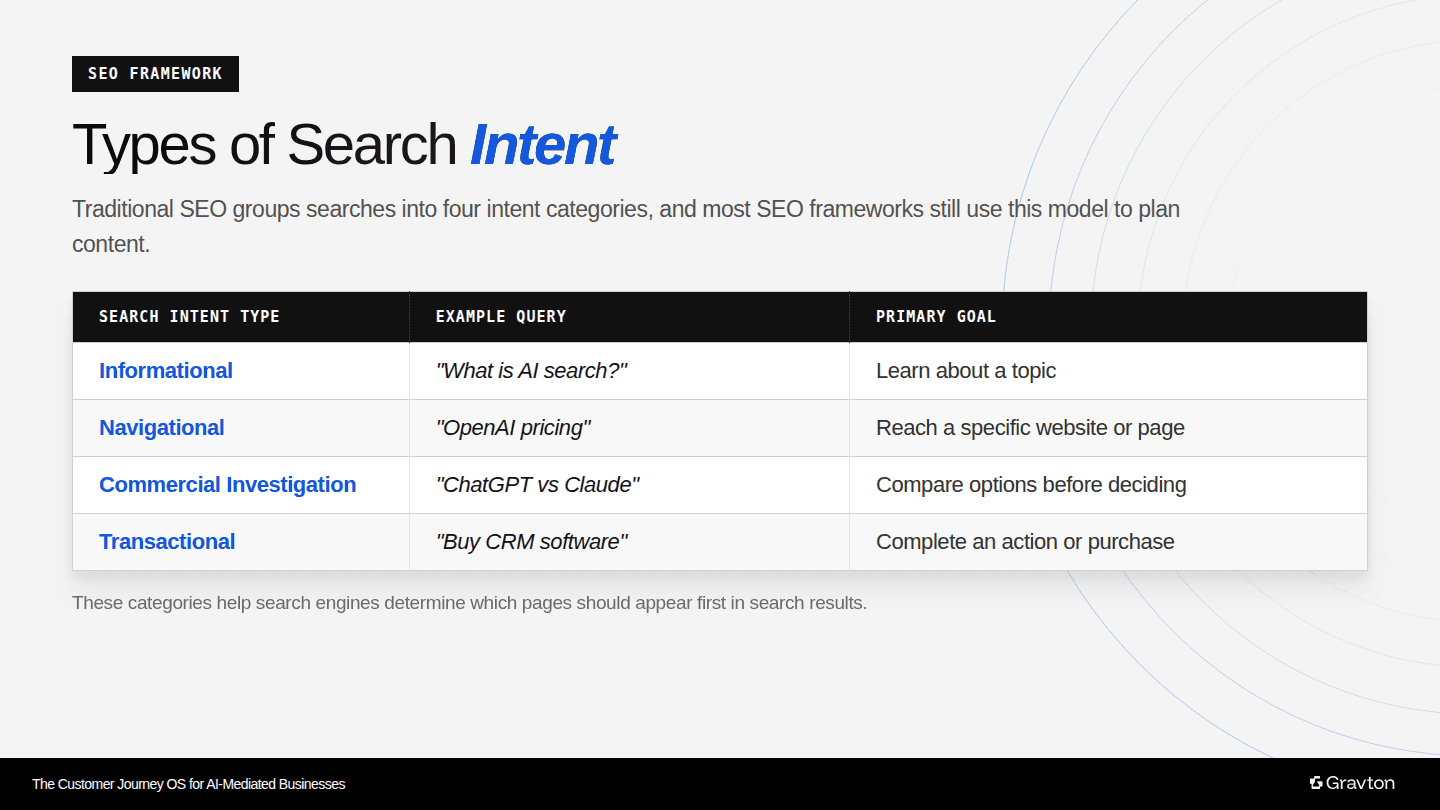
Figure 1: Types of search intent.
These categories help search engines determine which pages should appear first in search results.
Types of AI intent
AI intent goes beyond keyword classification. Instead of assigning a prompt to one category, an AI model determines what the user is actually trying to accomplish.
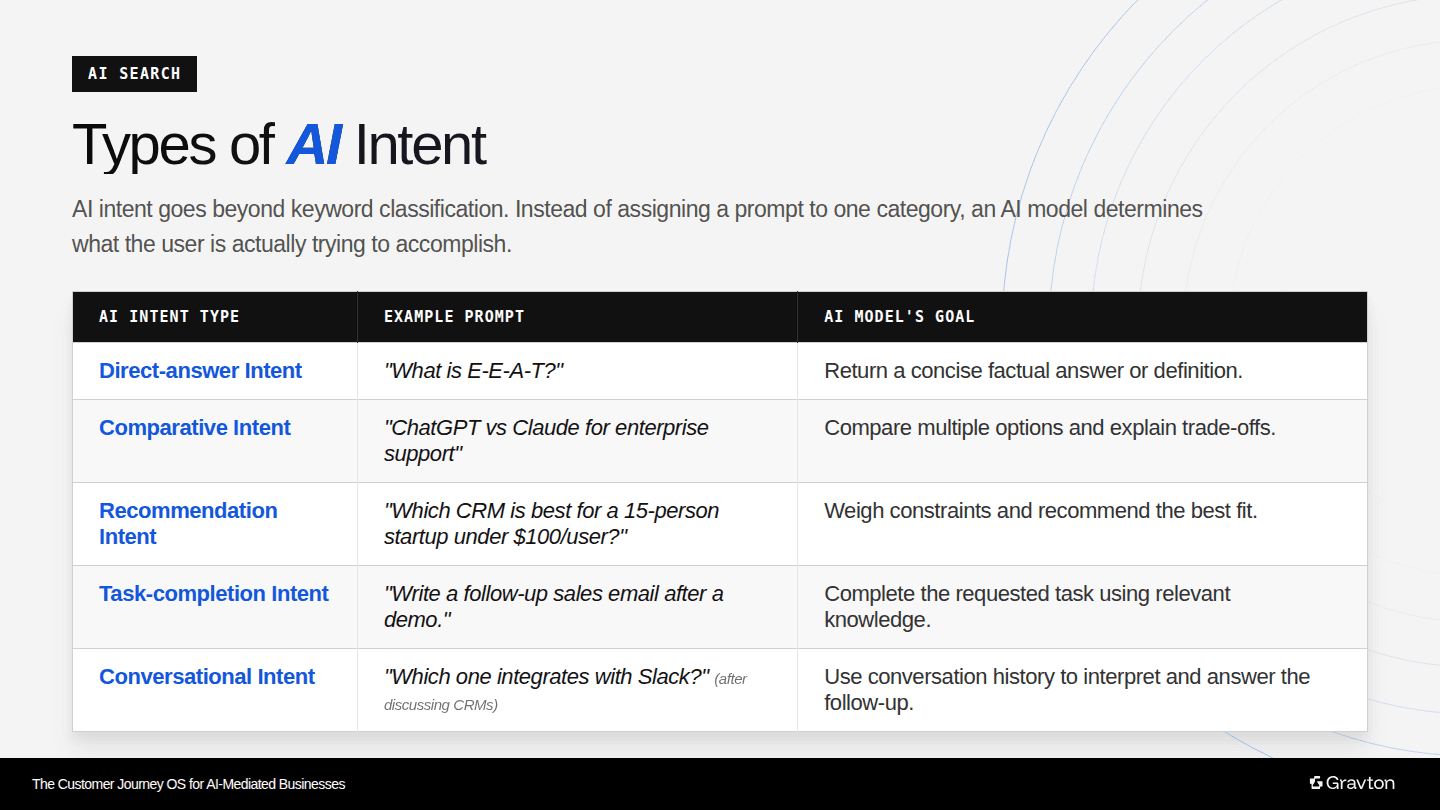
Figure 2: Types of AI intent.
The main difference between search intent and AI intent is granularity. Search engines typically categorize a question into one main intent to rank web pages. In contrast, AI models look at several layers of intent. This includes the user's goal, context, constraints, and expected output to generate a single response. As prompts become longer and more conversational, intent becomes less about keywords and more about understanding the complete task.
Read more on Intent Intelligence: Understanding Why Users Ask What They Ask and Prompt Market Analysis: What Buyers Actually Ask AI
How does traditional search intent compare to AI search intent?
Here are the practical differences across the dimensions that matter for content strategy.
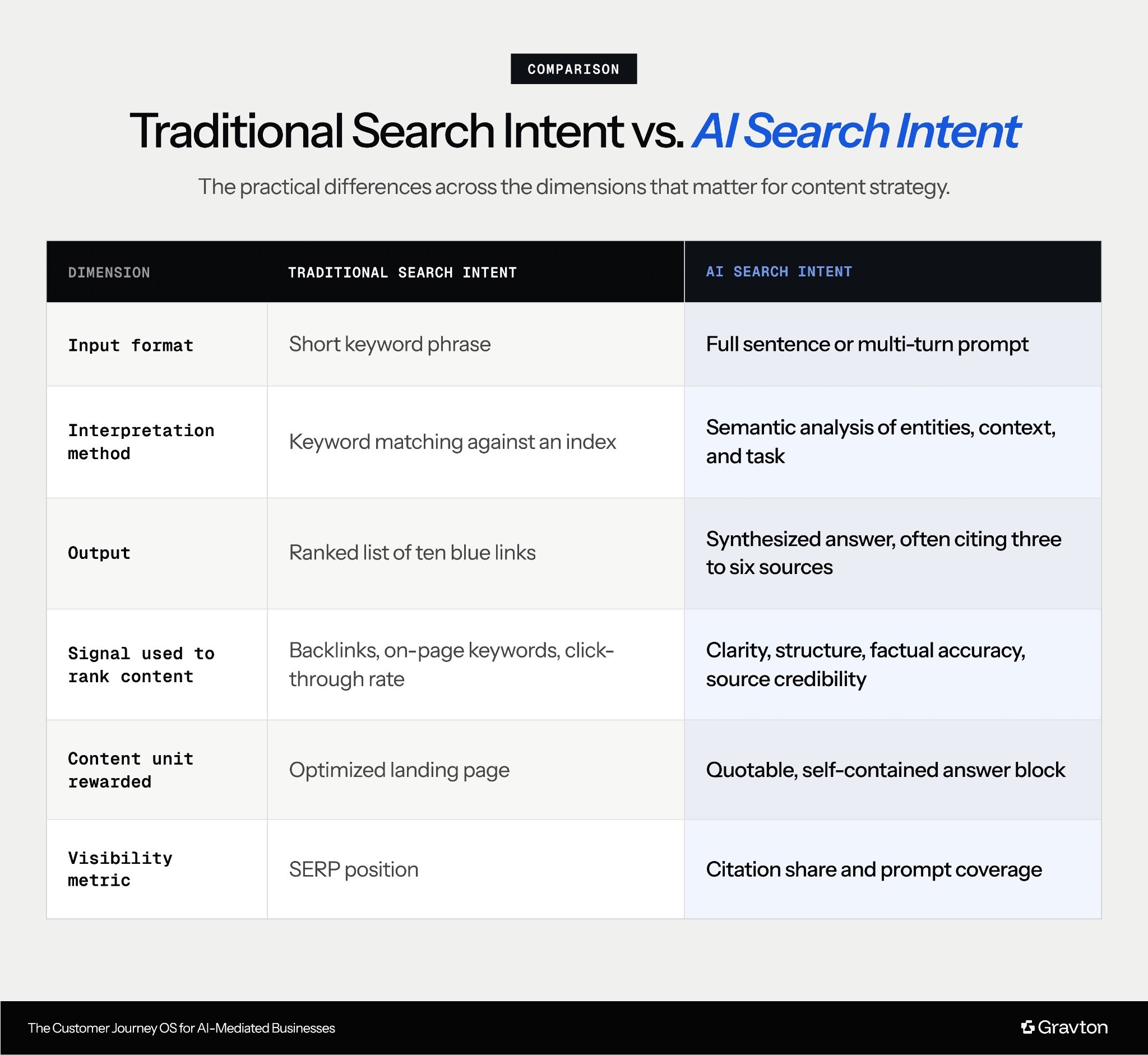
Figure 3: Traditional search intent vs. AI search intent.
Conversational search intent sits inside this second column. It is the version of AI search intent that carries memory across turns, so a follow-up question like "and which one integrates with Slack" only makes sense because the system retained the earlier context about CRM software.
How does conversational search intent change informational intent in AI search?
Intention AI search no longer ends with a definition. In traditional search, an informational query returned a list of pages explaining a concept, and the user picked one to read. In AI search, the model reads several sources, extracts the relevant facts, and delivers a direct answer inside the same response.
This changes what "ranking" for an informational query even means. Your content is not competing to be clicked. It is also competing to become one of the sources an AI model retrieves and cites in its answer.
A page written as a wall of prose gives an AI system fewer clearly defined passages to extract than a page with clear definitions, labeled sections, or short factual statements that can stand on their own.
Where does E-E-A-T fit into AI intent recognition?
E-E-A-T stands for experience, expertise, authoritativeness, and trustworthiness, the framework Google introduced to judge content quality. Google uses these concepts in its guidance for evaluating helpful, reliable, people-first content. AI search adds another layer: your content still needs to provide information an AI system can understand, retrieve, and use when constructing an answer.
See Intent Intelligence: Understanding Why Users Ask What They Ask
Three things carry the most weight in that judgment.
First, named authorship and clear sourcing, since a model has an easier time trusting a claim it can attribute.
Second, specific, checkable facts instead of vague claims, since specificity is what makes a sentence quotable.
Third, consistency across your site, since a model that sees the same facts repeated accurately across multiple pages treats your domain as a more reliable source.
Who needs to track search intent vs AI intent separately?
Any team running both organic search and AI visibility programs needs to track these as two separate systems, not one dashboard with two labels. An SEO manager optimizing for keyword rankings is solving a different problem than a content lead trying to get cited inside a ChatGPT or Perplexity answer.
Marketing leaders comparing quarter-over-quarter performance are the group most exposed to this gap. If your reporting only tracks keyword rank, you will see traffic decline as AI Overviews and chat interfaces absorb informational queries, with no explanation for where that traffic went. AI search visibility tracking closes that gap by measuring citation share and prompt coverage alongside your existing SEO metrics.
When should you optimize for AI intent instead of traditional search intent?
You do not choose one over the other. Both systems run at the same time, and most buyers still move through search engines even as they also query AI assistants. The table below is a simple guide for where to put your effort first.
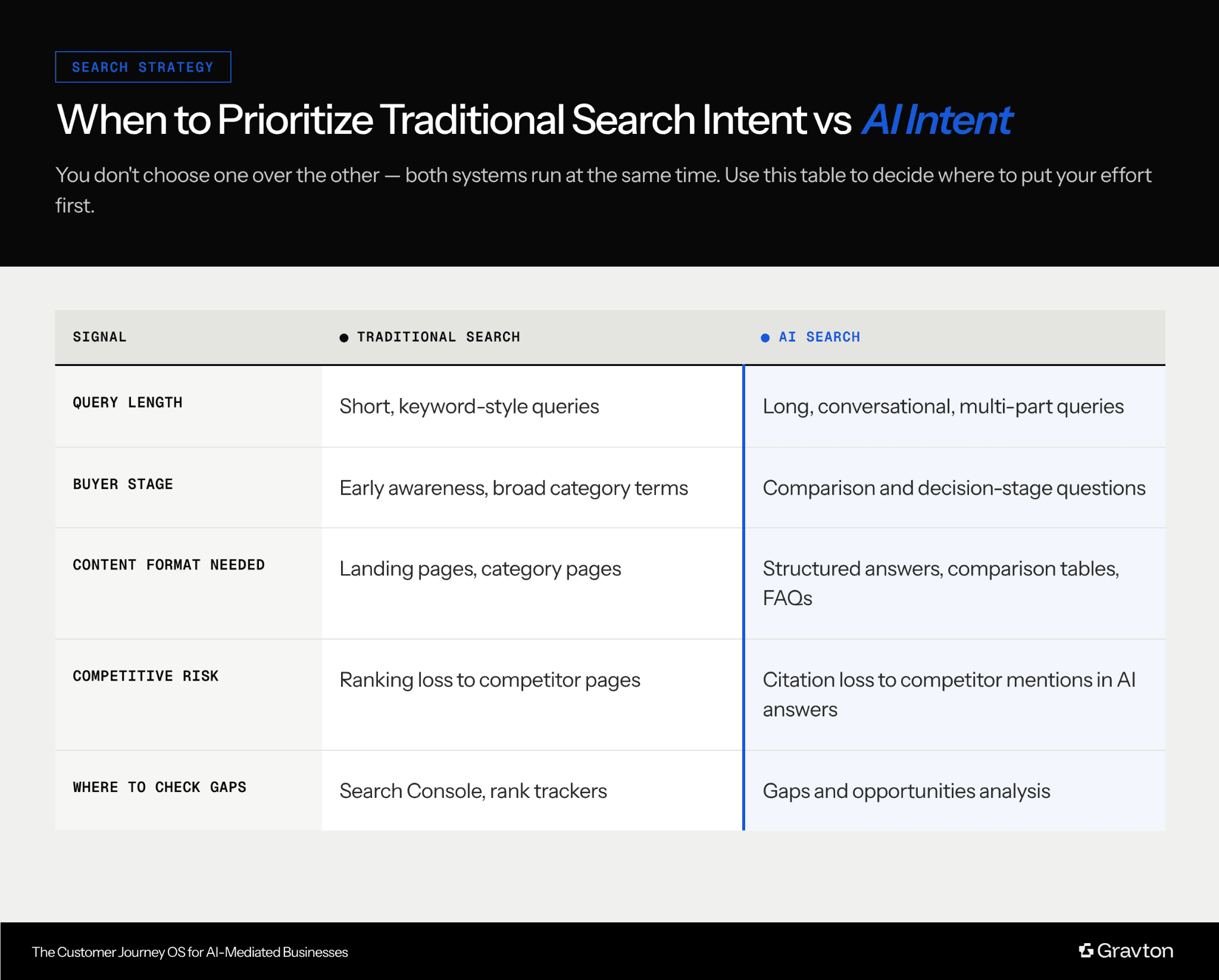
Figure 4: Prioritizing Traditional search intent vs. AI intent.
How does Gravton help you track Search Intent vs AI Intent?
Gravton's view is that search intent vs AI intent is not a debate to resolve but two layers of demand you need to measure at the same time. Most teams have solid traditional search intent data and almost no visibility into how AI models classify and answer the same buyer's conversational search intent. Read more on how Gravton tracks AI search visibility for the full picture of how this works in practice.
The Insights Engine maps the prompts your buyers actually ask, so you can see where informational intent in AI search is being served by competitors instead of you. The Opportunity Engine ranks those gaps by impact, so your team is not guessing which prompt to fix first. The Content Studio then turns that gap analysis into AI-ready content built for citation, not just for ranking.
Search intent and AI intent will keep diverging as more of the buyer journey moves into conversational interfaces. Tracking only one of them means reporting on half your funnel.
FAQs on what is Search intent vs AI intent
What is search intent and how is it different from AI intent?
Search intent classifies a keyword into a category for ranking purposes. AI intent interprets the full meaning of a prompt, including entities and implied tasks, to generate a direct answer.
Does conversational search intent replace traditional search intent?
No. Conversational search intent adds a new layer on top of traditional search intent. Buyers still use short keyword searches, but they increasingly also use multi-turn conversational prompts, and both need separate tracking.
Why does informational intent in AI search need different content?
Informational intent in AI search rewards content that is quotable and self-contained, since AI models extract and cite specific facts rather than sending users to a full page.
How does E-E-A-T apply to AI intent recognition?
AI models weigh the same signals E-E-A-T describes: named authorship, specific and checkable facts, and consistency of claims across a domain, when deciding which sources to cite.
Who should be responsible for tracking AI search intent?
Marketing and content teams already running SEO programs should own this, since AI search intent measurement extends their existing reporting rather than replacing it.
Find your AI search visibility gaps
See which questions surface your brand, which ones send buyers to competitors, and where your content has visibility gaps.
VISIBILITY & CONTENT STRATEGY