
Understand How GPT Sees the Web
Understand How GPT Sees the Web
How GPT sees the web, explained. Learn how GPT understands the web, where its knowledge comes from, and how to make your content easier for it to find.
Haritha Kadapa

Highlights
GPT's knowledge is a frozen snapshot, not a live view: GPT has no real-time access to the web by default. It works from patterns learned during training, which stopped updating on a fixed cutoff date.
Retrieval is what makes current answers possible: For anything time-sensitive, GPT runs a live search and reads back a handful of pages before answering, separate from its frozen training data.
Trust builds from repetition, not a single source: GPT favors sources that appear often and consistently in training data and rank as authoritative during retrieval.
Thin content lets competitors define your brand: If your own site lacks specifics, GPT will lean on a more complete competitor page instead, even when it isn't yours.
Clear structure wins in both modes: Content written in plain, well-defined, fact-dense terms is easier to cite whether GPT is drawing on training data or live retrieval.
If GPT describes your brand using a competitor's information, the problem may be what the model can find and understand about you.
GPT does not browse the internet the way you do. It has no browser tab, and no live view of any webpage unless a specific tool gives it one. What GPT "sees" is a compressed, statistical representation of text it was trained on, built long before you typed your question. Think of it like a well-read colleague who stopped reading new material on a fixed date. They can discuss almost anything from before that date, but nothing after it, unless someone briefs them first.
Understanding how GPT sees the web changes how you think about content, visibility, and what actually reaches your customers.
This article breaks down how GPT understands the web in plain terms: where its knowledge comes from, how LLM web crawling fits into the picture, and what you can do to show up in its answers.
How does GPT learn about the web in the first place?
GPT learns from AI training data: massive collections of text gathered from webpages, books, articles, forums, and other public sources. During training, the model processes this text and adjusts billions of internal parameters to predict what word is likely to come next in a sentence.
Read more on How Sources Get Selected?
This process does not store webpages; it stores patterns. GPT cannot quote your homepage from memory, but it can generalize the ideas, facts, and associations that appeared across many similar pages during training. This is also why outdated pricing, product names, or company details sometimes show up in its answers; it is working from a snapshot of the web that stopped updating the moment training ended.
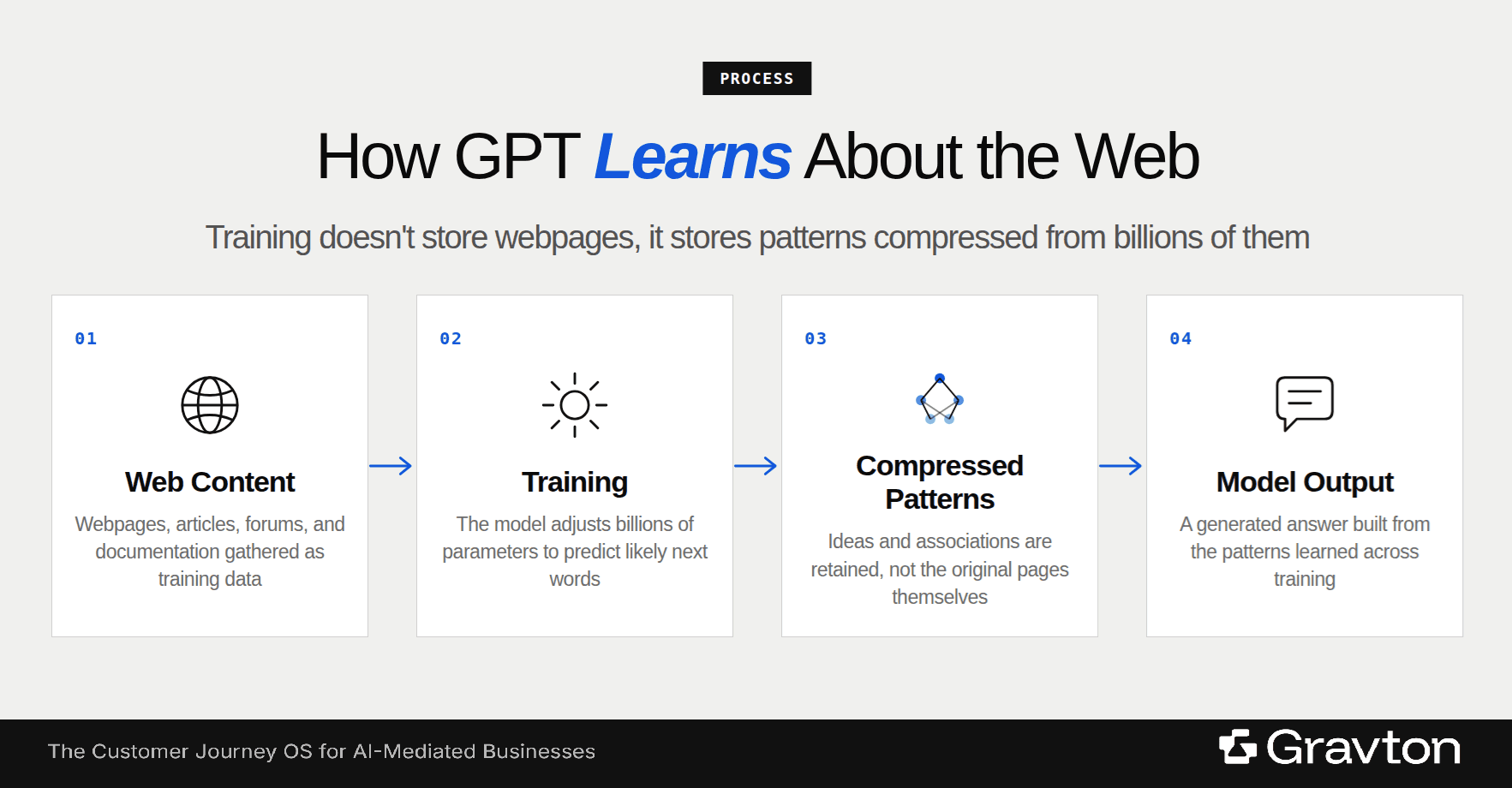
Figure 1: How GPT learns about the web.
How does GPT access real-time information when it needs to?
Modern GPT systems solve the freshness problem with retrieval. When a question needs current information, GPT information retrieval kicks in: the system runs a live web search, pulls back a handful of relevant pages, and reads them before answering. This is separate from the model's frozen training data, and it is technical GEO and AI crawlability that determines whether your pages are even eligible to be pulled in.
This is the moment your content has a real chance to be seen. If your page is not crawlable, not indexed, or badly structured, it cannot be retrieved even if it is exactly what the user needs.
|
For stable, well-established facts, GPT usually answers from training data alone; there is no need to search the web for something unlikely to have changed. For anything time-sensitive, such as current pricing, recent news, or a product launched last month, GPT leans on retrieval instead. Evergreen explanations earn their place in training data over time; timely, specific pages earn their place through retrieval today. A durable content strategy needs both.
Read more on Grounding in AI search.
Who decides which sources GPT trusts?
No single switch controls this. When an AI system retrieves web sources, relevance, content quality, authority, and other signals can influence which sources are selected. Different AI systems also use different retrieval and ranking processes, so there is no single formula that determines whether a page will be cited.
Research into Generative Engine Optimization has found that generative search systems can differ significantly in the sources they select and the way they respond to different queries and phrasing.
Sources that are cited elsewhere, structured clearly, and consistent over time tend to carry more weight, a dynamic covered in more depth in Citation Graph & Source Influence.
|
Where does GPT get its facts about your brand?
GPT forms an impression of your brand from whatever public content mentions you: your own website, review sites, forums, press coverage, comparison pages, and documentation. It does not visit your site and take your word for it; it cross-references what many sources say and favors the pattern that repeats.
If your own site is thin on specifics while a competitor's comparison page is detailed and well-cited, GPT will lean on the more complete source, even if it is not yours.
|
How can you make your content easier for GPT to understand?
Write in clear, direct sentences that define your terms and state facts plainly. Structure pages with real headings, short paragraphs, and specific numbers instead of vague claims.
For retrieved content, these practices make the information easier to process and evaluate. Research into generative search also points to the importance of content that is easy for AI systems to process and use when constructing answers.
This applies to both what GPT learned during training and what it retrieves live today; content built this way leaves less room for misreading, in either mode.
Read more on Core GEO Best Practices.
|
Gravton’s view
GPT does not see the web the way a person does. It sees a frozen snapshot from training, refreshed only when retrieval pulls in something current. Brands that write vague, unstructured content stay invisible in both modes. Brands that write clear, well-structured, fact-dense pages get cited in both.
For brands, the practical problem is visibility. If your content is vague, incomplete, difficult to retrieve, or missing information buyers need, another source may become the one an AI system uses instead.
Gartner has also advised marketing teams to adjust their web content strategies as GenAI-powered search becomes a larger part of how customers discover information.
Gravton Labs tracks how your content actually performs inside this system, across every major AI platform, so you can see the gaps and close them with evidence instead of guesswork.
Read more in How Gravton Labs Helps You Track AI Search Visibility.
FAQs on How GPT Sees the Web
What is the difference between GPT's training data and retrieval?
GPT answers many questions using patterns learned during training. For questions about recent events, pricing, or new products, it uses retrieval to search and read current webpages before responding.
Why might GPT describe a brand using another website?
GPT builds an understanding of your brand from public information across your website, reviews, forums, press coverage, comparison pages, and documentation. If another source provides more complete or better-supported information, GPT may rely on it instead.
Who decides which sources GPT trusts?
Trust comes from how consistently a source appeared during training and how authoritative and relevant it is during live retrieval. Sources that are well cited, clearly structured, and consistent over time tend to carry more weight.
How to make content easier for GPT to understand?
Use clear language, define important terms on first use, organize content with headings and short paragraphs, and include specific facts with verifiable sources instead of vague claims. Well-structured content is easier for GPT to understand during both training-based responses and live retrieval.
Find your AI search visibility gaps
See which questions surface your brand, which ones send buyers to competitors, and where your content has visibility gaps.
VISIBILITY & CONTENT STRATEGY