Turning AI Search Gaps Into Prioritised
Revenue Actions
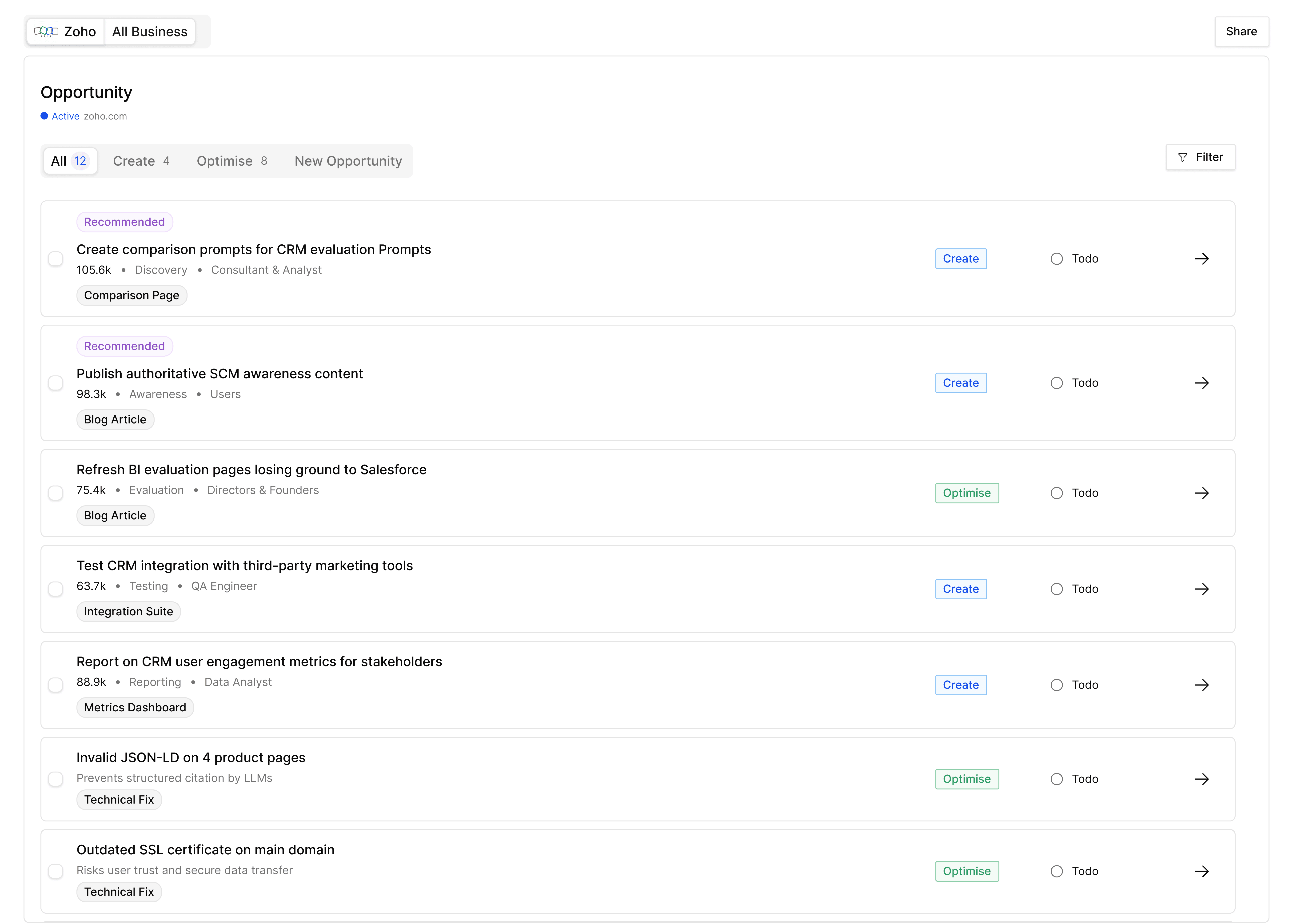
THE ENGINE
What the Opportunity Engine does
The Opportunity Engine is Gravton’s system for converting AI visibility insights into prioritised, execution-ready workflows.
It analyses where a brand is underperforming across prompts, topics, competitors, and stages of the buyer journey, then identifies the actions most likely to improve visibility, competitive positioning, and commercial outcomes.
The distinction between our Opportunity Engine and a standard analytics dashboard is worth stating directly. Most reporting tools answer the question: what happened? Our Opportunity Engine answers: what should happen next, and in what order? It tells teams
The result is a living intelligence map across the AI platforms that gives marketing teams confidence in their competitive position.
OPPORTUNITY
How the Opportunity Engine works
0
1
.
Discovery and prioritisation
The first stage identifies where a brand's AI visibility most needs improvement.
Our Opportunity Engine begins analysing high-level topics tied to the company's:
Market
Products
Competitive positioning
Buyer intent
Within each topic cluster, it evaluates performance across a structured set of dimensions.
This analysis identifies opportunities by business relevance.
It is also worth mentioning that not all visibility gaps carry the same commercial weight. For example, A cybersecurity company may find that it performs well on educational, awareness-stage prompts but is consistently excluded from mid-funnel vendor comparison queries. The Opportunity Engine surfaces these commercially critical gaps and ranks them accordingly, ensuring that teams invest their resources where improvement will have the greatest downstream impact on the pipeline.
Metrics Evaluated | What it Reveals |
|---|---|
| Prompt Volume | The scale of buyer demand in this conversational space |
| Visibility Score | Current brand presence within AI responses for this prompt set |
| Sentiment Score | Whether the brand is framed positively, neutrally, or poorly when mentioned |
| Competitive Positioning | Which competitors dominate this space and by how much |
| Citation Frequency | How often AI systems reference the brand's content sources |
| Share-of-voice Changes | Whether the brand's AI presence is growing or declining over time |
| Funnel Stage Impact | Whether this gap affects discovery, evaluation, or decision-stage conversations |
0
2
.
Opportunity classification
Once opportunities are identified and ranked, our system determines the most effective strategic response for each one.
This is where the Opportunity Engine operates at a meaningfully higher level of sophistication than a standard reporting tool.
Rather than simply flagging a gap, it classifies each opportunity according to several strategic dimensions:
Content approach
The content approach determines whether there is an opportunity for
Creating net-new content
Remodelling an existing high-performing asset
Refreshing outdated material
Scaling into a broader topic cluster
Content structure
Content structure determines which format AI cites most likely:
Comprehensive guide
Structured comparison
FAQ module
Technical explainer
Product-focused page
Review-oriented asset
Funnel intent
Funnel intent determines at which stage of the funnel there is an opportunity:
Top-of-funnel awareness
Mid-funnel evaluation
Bottom-of-funnel decision support
Post purchase support
Placement type
Placement type determines whether the priority is
Owned media
Operated properties
Improving the brand's earned ecosystem references that AI systems actively trust
This four-stage sub-classification ensures that every recommendation is matched to a specific reason for the loss of visibility.
For example, If competitors are dominating "Product A vs Product B" prompts, our Opportunity Engine may recommend a structured comparison page with feature-level comparison tables, technical differentiation sections, pricing transparency, and AI-readable FAQ blocks.
For example, If the issue is that existing content is outdated or structurally difficult for AI systems to parse, the recommendation shifts toward refresh and restructuring work.
0
3
.
Opportunity scoring
The Opportunity Engine also includes a prioritisation scoring model. Each opportunity is ranked according to its expected impact across multiple dimensions:
Revenue relevance
Competitive pressure
Citation volatility
Buyer intent strength
Existing authority signals
Execution feasibility
This scoring system provides marketing teams with a current list of opportunities they can confidently pursue. Instead of relying on outdated SEO plans based on old data, teams use a live intelligence feed that shows the current state of AI visibility. This feed updates automatically as prompt patterns change, new competitors appear, and citation sources shift.
0
4
.
Execution readiness
The fourth stage, the final stage, transforms prioritised opportunities into action-ready production workflows.
Every identified opportunity flows directly into Gravton's Content Studio. It removes the operational gap between insight generation and content execution.
For example, suppose a team selects an opportunity for action, the system automatically pre-populates the essential context for execution, including:
Target topic
Specific prompts to address
Content goals
Funnel intent
Recommended structure and format
Suggested keyword and entity coverage
Competitive references
Visibility gap context that originated the opportunity
This pre-populated workflow dramatically reduces planning overhead while ensuring that every piece of content produced is grounded in real AI visibility intelligence.
Final thoughts
The central operational challenge in AI search optimization is not discovering that gaps exist. It is knowing which gaps to prioritise, what actions will actually address them, and how to translate that intelligence into execution quickly enough to matter competitively.
Our Opportunity Engine changes AI search optimization from a reactive content initiative into a proactive revenue strategy. It treats AI visibility as a leading indicator of commercial performance.