
Where SEO Ends and GEO Begins
Where SEO Ends and GEO Begins
Where SEO ends and GEO begins: Understand why SEO is the foundation, while GEO drives AI citations, and how Gravton bridges both for AI search visibility.
Haritha Kadapa

Highlights
SEO is the foundation: While Search Engine Optimization (SEO) helps in content discovery, Generative Engine Optimization (GEO) determines whether AI platforms choose to cite it.
Gravton builds where SEO stops: Instead of recreating traditional SEO tools, Gravton focuses on AI-native capabilities such as citation intelligence and prompt visibility intelligence.
Integration over replacement: Gravton works alongside your existing SEO stack and integrates signals from tools like Google Search Console rather than replacing them.
Focused on the SEO signals that matter: Gravton prioritizes technical SEO, on-page optimization, and AI-specific content quality because these have the strongest impact on AI citations.
Built to be the system of record for AI visibility: Gravton combines SEO data, AI citation analytics, and GEO-native insights into a single platform for measuring and improving AI search visibility.
Google made a bold claim in May 2026: GEO isn't a separate discipline; optimizing for AI Overviews is simply optimizing for Search.
Independent research tells a different story. A recent DerivateX study, "Two Googles, One Query," found only 35% overlap between top Google rankings and AI-cited sources across 100 B2B software queries, confirming the split with data from this quarter.
The truth sits between these positions: SEO foundations are necessary but no longer sufficient. That's the thinking behind Gravton SEO: we don't bolt a GEO layer onto an SEO platform, and we don't rebuild tooling that already works. We integrate the SEO signals that disproportionately drive AI citations, leave categories with mature incumbents alone, and go deep on the GEO-native territory where no SEO equivalent exists.
Here's how we got to that position and what it means for the way Gravton AI's SEO capabilities are built.
The question we're answering
Should a platform build for AI search visibility touch SEO at all? Too much dilutes positioning and pits you against incumbents like Ahrefs and Semrush. Too little, and you can't explain why a brand is or isn't getting cited.
We addressed this by testing the "SEO feeds GEO" hypothesis against the latest evidence, mapping SEO into seven sub-disciplines, scoring them by GEO linkage, and applying a build/integrate/ignore framework.
What Google said in May 2026
On May 15, 2026, Google published its first official guidance on optimizing for generative AI features. The message: GEO is SEO. AI Overviews and AI Mode run on the same ranking systems that have always driven organic results. Since the grounding technique is retrieval-augmented generation, an unindexed page can't appear in AI Overviews, one reason LLM indexing fundamentals still matter.
Google flagged four categories as not worth chasing: llms.txt files, content chunking, AI-specific rewrites, and inauthentic mentions. Schema markup isn't required for AI visibility, it noted, though it still helps traditional rich results. The guidance instead anchors three practices: non-commodity content with a genuine point of view, a clear technical structure, and optimized local and e-commerce details.
This matters, but it only speaks to Google's own AI surfaces, not ChatGPT, Perplexity, or Claude, which Google doesn't control.
What independent research shows
Outside Google's walls, independent research confirms the same pattern: traditional SEO success and AI citation success are converging less, not more. Sources older than one quarter have been retired below in favor of the freshest verified numbers:
Finding | What it means | Source |
Top Google rankings and AI-cited sources overlap just 35% across 100 B2B software queries | Ranking still doesn't reliably predict AI citation | |
YouTube mentions top correlate with AI Overview visibility (75,000 brands) | Off-platform presence can outrank on-site signals | |
AI Overviews cut click-through to top-ranking pages by 58%, up from 34.5% eight months earlier | Even when you rank, the traffic reward is shrinking |
Reconciling the two views
Both positions are correct within their own frame; the contradiction dissolves once you separate three things usually bundled together.
Preconditions are shared:
A page that isn't crawlable, indexable, or renderable can't be cited by any AI engine that relies on a search index. Technical SEO is the foundation.
Sufficiency mechanics have diverged:
Once indexable, being chosen as a citation differs from ranking as a top organic result. AI engines break content into passages, assess claim-level citability, and place heavy weight on originality, which is why ranking and structural signals serve only as strong correlations, not guarantees.
The source pool has expanded:
Perplexity leans on Reddit, AI Overviews draw on YouTube transcripts, ChatGPT synthesizes consensus across a broad pool, surfaces traditional SEO never addressed, and exactly where AI search optimization picks up the slack.
The linkage map
The diagram below illustrates how each SEO sub-discipline feeds into the underlying mechanics driving AI citations across major engines. The transmission layer in the middle column is the key insight.
Gravton’s own analysis shows that SEO disciplines do not connect directly to GEO outcomes. They connect through a set of intermediary properties that the AI engines actually evaluate. Mapping at this resolution makes it clear which SEO work has direct GEO leverage and which work has indirect or weak leverage.
This is the core proprietary lens Gravton sells: most vendors describe SEO and GEO as either the same discipline or entirely separate. Neither framing is operational. You can't build a roadmap or a sales answer from either.
The transmission layer is what makes the linkage testable: for each SEO input, we can point to the specific intermediary property (crawl completeness, passage-level structure, entity clarity, off-site co-occurrence) that actually reaches the AI engine's evaluation, and we can show, discipline by discipline, whether that path is strong, indirect, or effectively absent.
That's what turns "SEO matters for GEO" from a hand-wave into a scoring framework a prospect can act on.
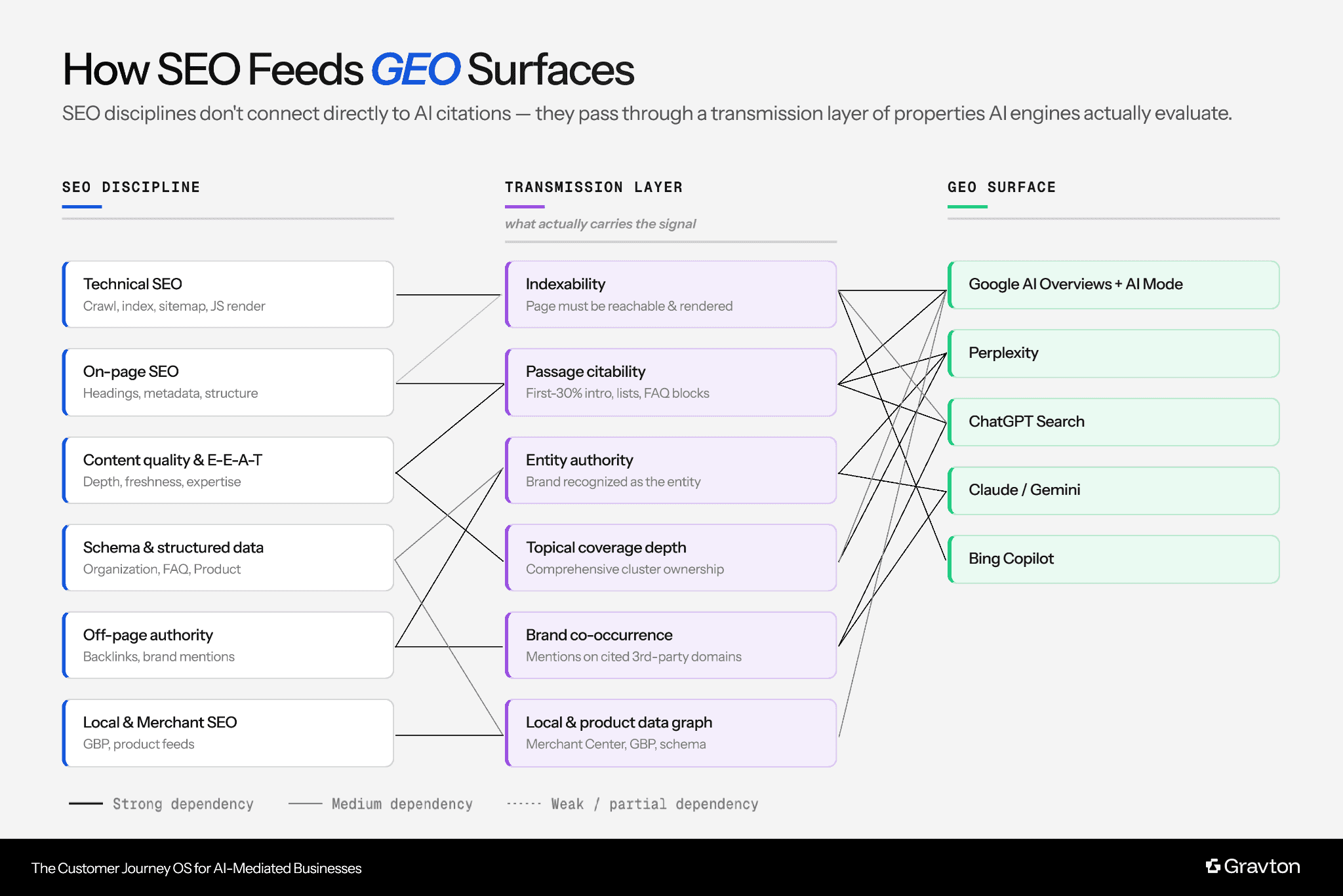
Figure 1: How SEO disciplines feed GEO surfaces through the transmission layer.
A categorical map of SEO, scored for GEO leverage
SEO Category | What it covers | GEO leverage | Strength |
Technical SEO | Crawlability, indexing, sitemaps, JS rendering, Core Web Vitals | No AI engine can cite an unindexed page | Strong |
On-page SEO | Titles, meta, heading hierarchy, internal links, semantic HTML | Directly shapes passage-level citability | Strong |
Content quality & E-E-A-T | Expertise, depth, freshness, original viewpoint | Largest correlating factor with LLM citation | Strong |
Schema & structured data | Organization, FAQ, Product, LocalBusiness markup | Not required for GEO; helps entity disambiguation | Medium |
Off-page authority | Backlinks, brand mentions, digital PR | Strong but indirect, drives brand co-occurrence | Strong |
Local & Merchant SEO | GBP, Merchant Center, product feeds, NAP | Matters mainly for shopping/local queries | Vertical |
Analytics & Search Console | Position, click, and query data via GSC/GA | Input layer for prompt clustering | Strong |
What doesn't come from SEO at all
The diagram below maps the six categories that exist only in the GEO world. These are the categories in which Gravton has no incumbent to compete with and where our defensibility is highest.
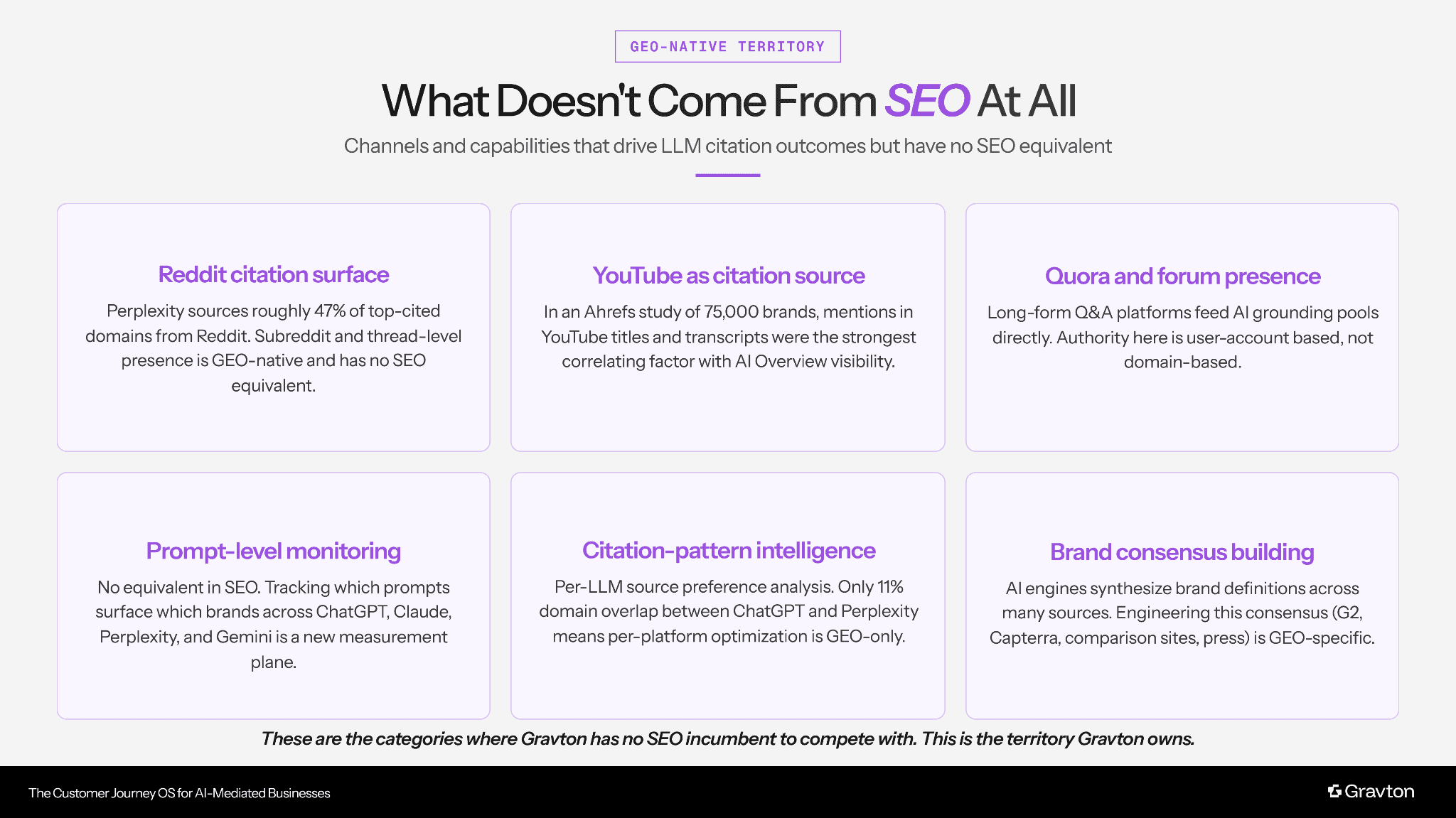
Figure 2: The GEO-native territory: capabilities and channels that drive AI citation outcomes but have no SEO equivalent.
Two of these (Reddit and YouTube presence) are at the channel level.
Two (prompt-level monitoring, citation-pattern intelligence) are measurement-level.
Two (Quora/forum presence, brand consensus building) are strategy-level.
Together, they form the spine of what a true GEO platform should own. They are where Gravton's product roadmap is already heaviest, and that is correct.
Where Gravton stands
We are a GEO platform that respects SEO foundations, not a GEO layer stacked on an SEO platform. We integrate SEO signals where they improve our explanation of citation outcomes, skip redundant SEO functionality, and own the GEO-native territory outright.
This positioning question isn't just platform-vs-tool anymore; it's also platform-vs-managed-service. Agencies and MSPs are now pitching GEO as a delivered service: they'll run the citation-building and content work for a brand, not just hand over a dashboard.
Gravton answers that the two aren't substitutes. A managed engagement still needs a system of record to know what's working, which citations moved, which channels are driving them, and where the SEO-to-GEO transmission is weak. Most MSPs are building that measurement layer themselves, badly, as a byproduct of delivery.
Gravton is built to be that layer regardless of who executes the work, which means we can sit underneath an in-house team, an agency, or an MSP relationship without competing for the same budget line.
The pattern that emerges
We integrate; we don't rebuild. We own categories where existing tooling solves the wrong problem for AI visibility, passage-level on-page scoring, and AI-specific content quality.
We pull in via API the categories that existing tooling already solves cheaply: GSC, lightweight crawl, schema audit.
We skip off-page backlinks and local/merchant SEO, which are either dominated by entrenched incumbents or fall outside our use case.
Gravton is the system of record for AI visibility
We integrate your SEO data because AI engines still depend on search foundations; we don't replace your SEO tools.
See how Gravton Labs helps you track AI search visibility
That shapes three things
our roadmap prioritizes on-page audits and AI-specific content scoring over backlink tools and site audits; our sales team answers "we already have Ahrefs" with integration, not displacement; and increasingly, "we already work with an agency/MSP" with the same answer, we're the measurement layer, not a competing service; and our partnerships target Ahrefs, Semrush, and Sitebulb on data, GSC/GA natively, and Reddit/YouTube on channel intelligence.
SEO built the foundation. GEO is a different system on top of it, and Gravton is built for that, not the foundation.
FAQs on SEO inside Gravton
1. Is Gravton an SEO platform?
No. Gravton is a GEO platform built for AI search visibility. It incorporates the SEO signals that influence AI citations alongside your existing SEO stack.
2. Why does Gravton include SEO capabilities?
AI platforms still depend on SEO fundamental signals like crawlability, indexability, and content quality, which Gravton analyzes.
3. What SEO capabilities does Gravton provide?
Gravton focuses on SEO capabilities with the strongest GEO impact, including technical SEO fundamentals, on-page optimization, AI-specific content scoring, and integrations with Google Search Console and analytics.
4. What SEO capabilities does Gravton not provide?
Gravton intentionally doesn't build backlink analysis, enterprise site crawling, rank tracking, or local and merchant SEO. Those are mature categories already served by established SEO platforms.
5. Can Gravton work with our existing SEO tools?
Yes. Gravton is designed to complement tools like Ahrefs, Semrush, Sitebulb, and Google Search Console by adding AI-driven visibility insights that those platforms don't provide.
Win your AI search demand universe
Understand how Gravton combines SEO signals with GEO intelligence to help your brand earn more AI citations.
VISIBILITY & CONTENT STRATEGY