
What Is Reverse Prompting? How to Reconstruct the Questions Behind AI Search
What Is Reverse Prompting? How to Reconstruct the Questions Behind AI Search
Learn how reverse prompting helps marketers reconstruct AI search questions, analyze competitor citations, and find content gaps for GEO.
Haritha Kadapa

Highlights
Your competitor can reveal your content gaps: Working backward from an AI answer can help you identify the buyer question and information needed behind a competitor citation.
AI asks first: Reverse prompting is when the AI model gathers missing details from you through clarifying questions.
It works backward too: Beyond writing prompts, you can use the same logic in reverse, starting from an AI answer and inferring the question or information needed that likely produced it.
A research tool for AI visibility: Reconstructing the likely prompts behind a citation, yours or a competitor's, shows which questions your content may still need to answer.
Improves prompt optimization: Used forward, it sharpens your own prompts; used backward, it reveals the questions buyers may be asking AI systems about your industry.
Your competitor is getting cited by AI for questions your buyers are asking, but you don't know what questions are triggering those citations. Reverse prompting gives you a way to work backward from an AI answer, infer the likely question behind it, and find the content gap that may be helping your competitor appear.
Reverse prompting has two related meanings. In the common prompting sense, you give an AI model a goal and let it ask clarifying questions before producing an answer. For AI search and Generative Engine Optimization (GEO), the more useful application is working backward from an AI answer to understand the question, intent, and information needed behind it.
That second use turns reverse prompting into a research method. Instead of starting with a keyword and guessing what buyers might ask, you start with an actual AI response and investigate why a particular source was cited.
This article explains what reverse prompting is, how it differs from writing a prompt the usual way, and why it matters for anyone thinking about AI search optimization and how brands get cited in AI answers.
What is reverse prompting?
Reverse prompting is a technique where the AI model asks the questions first. You state a goal in plain terms like "help me write a product launch email. ASk me any questions you need before writing it."
The model responds with a handful of clarifying questions, such as who the audience is, what tone to use, and what the call to action (CTA) should be. It gives you the output only after gathering those answers from you.
There is also a second way to use the idea. Instead of moving from a prompt to an answer, you move from an answer back toward the question that could have produced it. That backward process is especially useful for AI search research.
This is the opposite of traditional prompting, where you are expected to anticipate every detail the model might need and pack it all into a single instruction.
Reverse prompting treats prompt-writing as a conversation, not a one-shot request. It is one of several AI prompting techniques built around the idea that good output depends on good input, and that input is often clearer when it is built collaboratively.
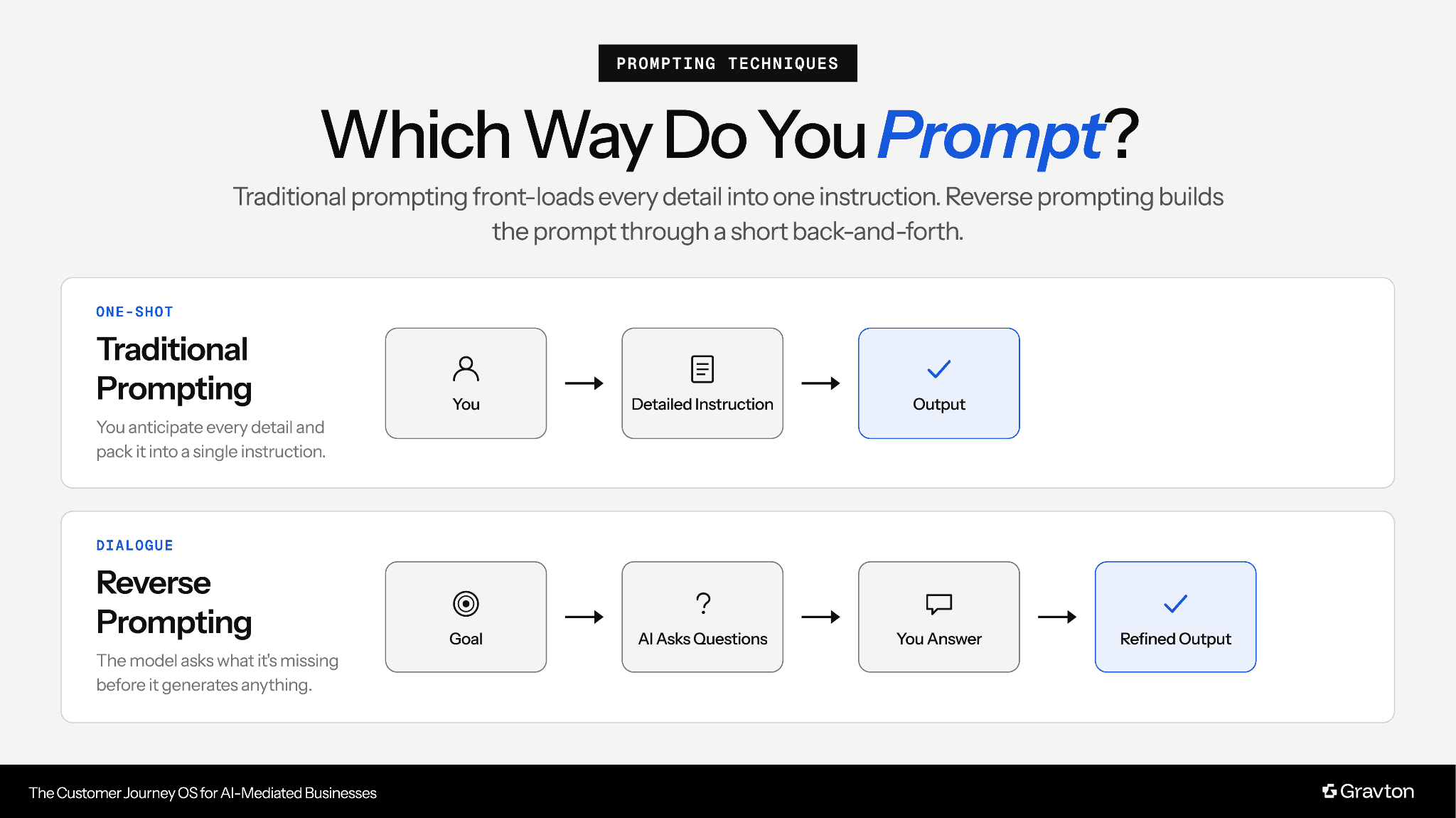
Figure 1: Traditional prompting vs. Reverse prompting.
Why does reverse prompting improve AI prompting techniques?
Reverse prompting helps because most people do not know what a model needs to know until the model asks. When the model asks instead of guessing, it surfaces the exact gaps that would otherwise produce a generic or off-target answer.
This shifts the burden of prompt optimization away from trial and error. Instead of rewriting a prompt three or four times after a disappointing response, you answer two or three targeted questions once, and the output is usually closer to what you needed on the first real attempt.
How does reverse prompt engineering work?
Reverse prompt engineering works in three steps.
First, you give the model a short, plain-language goal instead of a fully specified instruction.
Second, you explicitly ask it to gather any missing details through questions before answering. A simple instruction like "ask me clarifying questions first" usually triggers this.
Third, you answer those questions, and the model uses your responses to build a more complete internal prompt before generating its output.
This process also applies in reverse, in a more analytical sense. Instead of writing a prompt and observing the output, you can work backward from an AI response to figure out what prompt or question likely produced it.
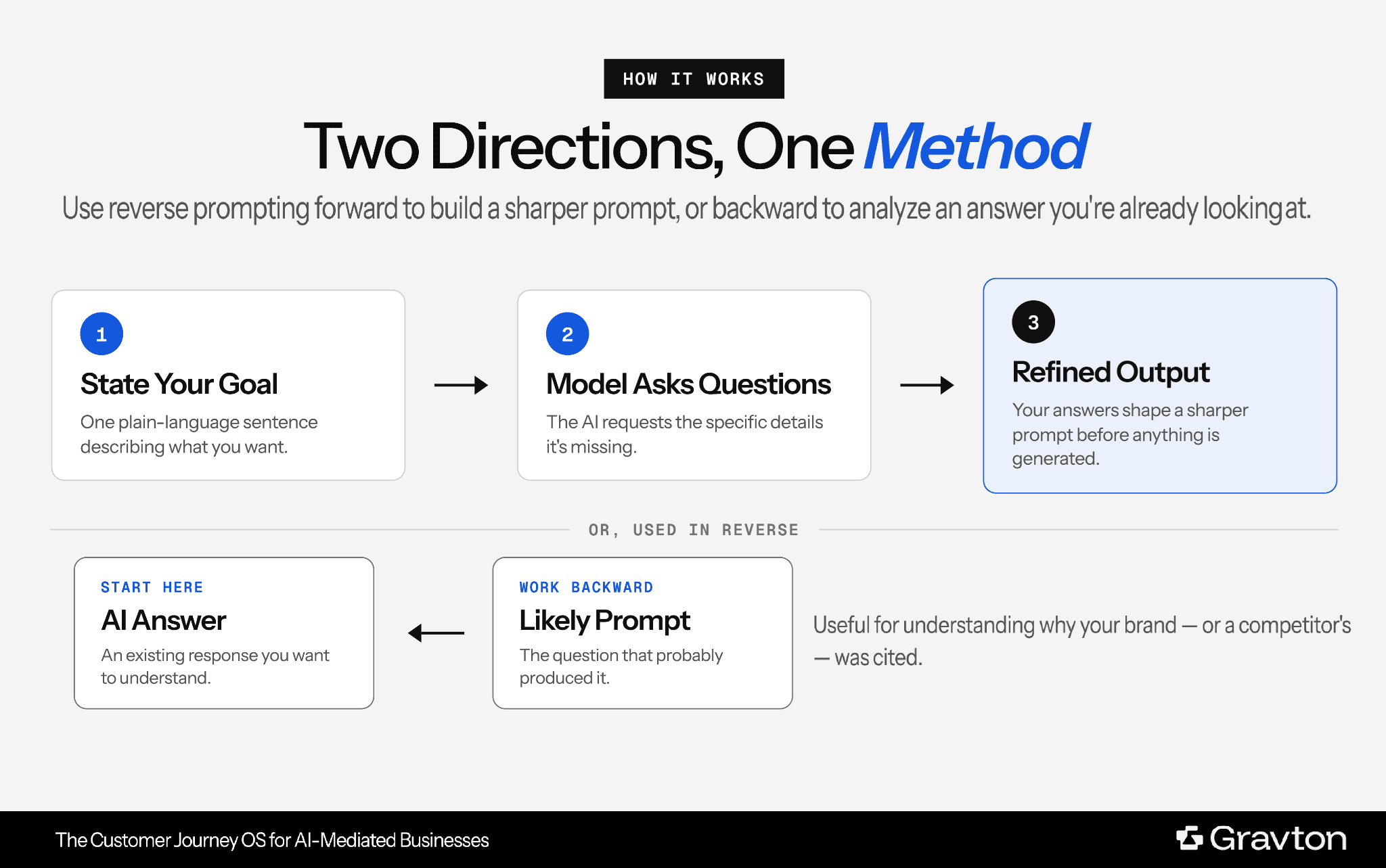
Figure 2: How reverse prompting works, forward and backward.
This form of prompt analysis is useful when you are trying to understand why a model gave a certain answer, or what someone probably asked to get it.
Google's AI search systems can break complex questions into related searches and combine information from multiple sources when generating a response, which is one reason marketers need to think beyond a single keyword when analyzing AI search behavior.
Where does prompt optimization fit in?
Prompt optimization is the ongoing practice of refining prompts so a model produces more accurate, more consistent, or more useful output over repeated use.
Reverse prompting fits into this practice as a starting method rather than a final one. It helps you arrive at a stronger initial prompt, which you can then refine further based on results.
For content and marketing teams specifically, prompt optimization extends beyond a single conversation. It means understanding the range of questions people actually ask AI systems about a topic, and building content that answers those questions directly.
|
The backward version of reverse prompting adds another layer. When a competitor appears in an AI answer, you can analyze the citation and infer the question or information needed. That gives you a concrete starting point for content research instead of guessing which keywords might matter.
Who should use an LLM prompt strategy like this?
Anyone who regularly asks AI models for help with research, writing, or analysis benefits from a reverse prompting habit. It is especially useful for tasks with several moving parts: a technical explanation, a piece of long-form content, or a comparison between options, etc, where a single-shot prompt is unlikely to capture every requirement.
For marketing and content teams, an LLM prompt strategy built around reverse prompting also has a second use. It helps teams reconstruct the kinds of prompts real users type into AI search tools, which is a direct input into building AI-ready content that answers those prompts clearly the first time.
For GEO teams, the competitor use case is particularly useful. If a competitor repeatedly appears in AI answers, studying the questions and claims around those citations can help reveal the topics and information needs where your content may be missing.
When does prompt analysis matter most for AI visibility?
Prompt analysis matters most when you are trying to understand why your brand does or does not appear in an AI response. If you can reconstruct the likely prompt behind a citation or behind a competitor's citation, you can see what specific question your content needs to answer.
For example, if an AI platform cites a competitor when answering a question about AI visibility metrics, don't stop at the competitor's name. Look at what the cited page actually contributes to the answer. Is it a definition, a list of metrics, a statistic, a comparison, or an explanation of how the metric works?
Then turn the information needed into a question. What question would a buyer need answered for this source to become useful? That question can become a content gap worth investigating.
This is different from guessing at keywords the way traditional SEO does. AI models can respond to complete questions and complex requests, so prompt analysis means thinking in terms of the information a buyer needs and checking whether your content gives a direct, useful answer.
Research on generative search has also examined how AI-generated claims connect with their citations, showing why understanding the relationship between an AI answer and its cited sources matters when evaluating AI search visibility.
Read more on Prompt Market Analysis: What Buyers Actually Ask AI.
|
Gravton's view
Gravton treats reverse prompting as a research method. The same logic that sharpens a prompt through clarifying questions also helps you understand the prompts real buyers already use to reach AI search results.
Our AI Visibility tracking shows which prompts are pulling your brand into AI answers today, and which ones are pulling in a competitor instead. When a gap shows up, Content Studio helps you build the specific, direct answer that closes it.
You can read more about how we approach this in Gravton's AI search visibility tracking.
What should you do next?
Start with a prompt for anything non-trivial: state your goal in one sentence, then ask the model to gather the details it needs through questions.
Then apply the same thinking in reverse. Pick an AI answer relevant to your industry and work backward to the question that likely produced it.
Reverse prompting is a simple habit with two uses: it makes your own prompts better, and it gives you a clearer picture of the questions your content needs to answer. Both are worth building into a regular AI prompting practice.
FAQs on reverse prompting
What is reverse prompting?
Reverse prompting is a technique where you give an AI model a goal, and the model asks clarifying questions before responding, instead of you writing every detail into a single instruction.
How is reverse prompting different from regular prompt engineering?
Regular prompt engineering asks you to anticipate every detail the model needs in one shot. Reverse prompting shifts that work onto the model, which asks for the missing details through a detailed back-and-forth.
How do I trigger reverse prompting in a conversation?
State your goal in one sentence, then explicitly ask the model to gather any missing details through questions before answering. A line like "ask me clarifying questions first" is usually enough.
Can reverse prompting be used to analyze AI answers, not just write prompts?
Yes. You can work backward from an AI response to figure out what prompt or question likely produced it, which is a form of prompt analysis useful for understanding AI citations.
Why does reverse prompting matter for AI search visibility?
Reconstructing the prompt behind a citation, whether yours or a competitor's, shows the exact question your content needs to answer, which is more useful than guessing at keywords the way traditional SEO does.
Win your AI search demand universe
Discover the questions AI platforms answer about your category, see where competitors are getting cited, and uncover the content gaps keeping your brand out of the conversation.
VISIBILITY & CONTENT STRATEGY